

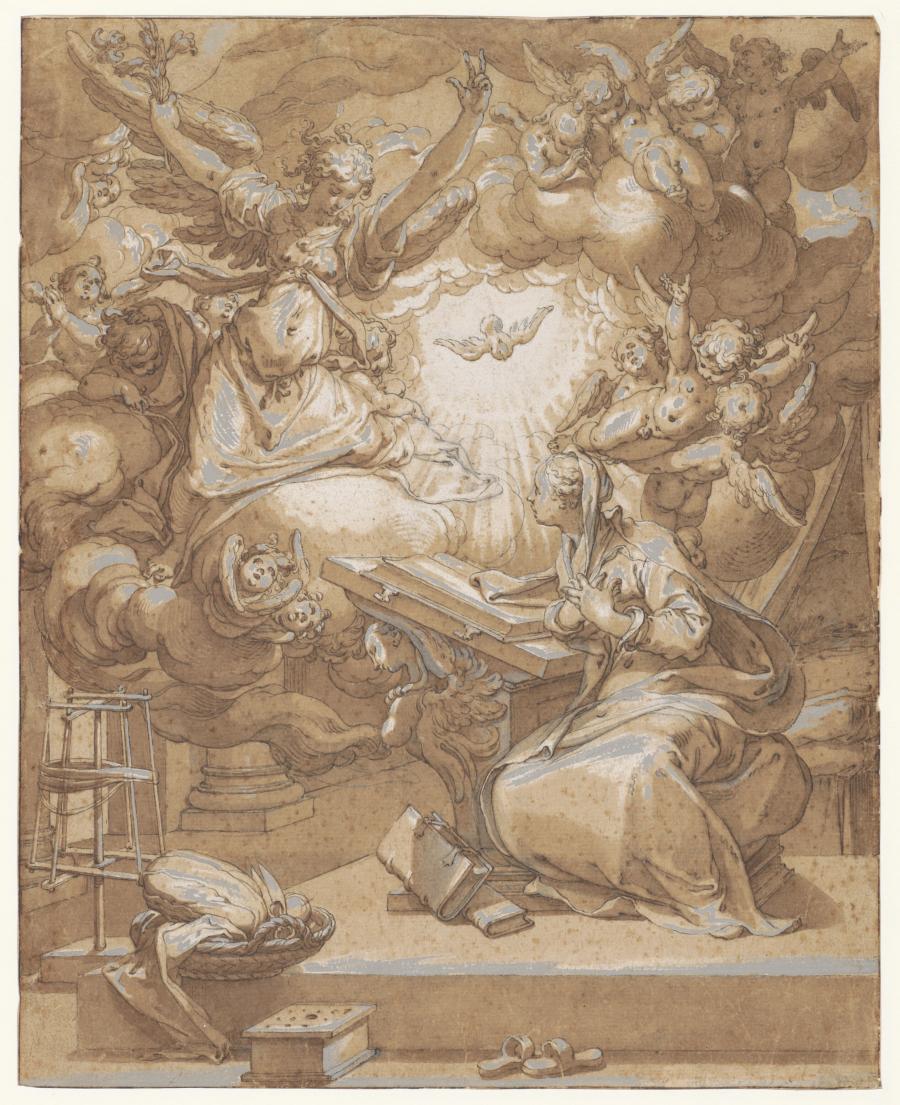
Dit is de ontwerptekening voor de (spiegelbeeldige) prent gegraveerd door Jacques de Gheyn II, gedateerd 1593. Linksboven is op een wolk de aartsengel Gabriël uitgebeeld, omgeven door engeltjes. Hij verkondigt de geboorte van Christus aan de rechts achter een lessenaar zittende Maria. Tussen hen in, centraal in de voorstelling, daalt de Heilige Geest in de vorm van een duif neer. Maria wordt verrast in haar bezigheid; alledaagse attributen als naaigerei, haar sloffen en een voetstoof liggen op de voorgrond.

Specificaties
| Titel | De annunciatie |
|---|---|
| Materiaal en techniek | Zwart krijt, pen in bruine inkt, bruin gewassen, wit gehoogd (grijs geoxideerd), doorgegriffeld, kaderlijnen (deels afgesneden) met de pen in bruine inkt |
| Objectsoort |
Tekening
> Tweedimensionaal object
> Kunstvoorwerp
|
| Locatie | Dit object is in het depot |
| Afmetingen |
Hoogte 345 mm Breedte 278 mm |
|---|---|
| Makers |
Tekenaar:
Abraham Bloemaert
|
| Inventarisnummer | A Bloemaert 1 (PK) |
| Credits | Aankoop 1866 |
| Collectie | Tekeningen & Prenten |
| Verwervingsdatum | 1866 |
| Vervaardigingsdatum | in circa 1592-1593 |
| Signatuur | '[..] fecit' (restant van een mogelijke signatuur, rechtsonder, in pen in bruine inkt) |
| Watermerk | geen (vH, 12P, fijn, folio) |
| Conditie | foxing, geoxideerde witte hoogsels (grijs) |
| Inscripties | (alles op de verso) ‘L:JO’ (linksonder, in potlood), ‘8’ (linksonder, in pen in bruine inkt), ’18-a’ en ‘No 3’ (linksmidden, in pen in bruine inkt), ‘44’ (rechtsonder, in zwart krijt), ‘91’ (rechtsonder, in potlood), ‘14’ (below left of centre, in pencil), ‘8 st / 2-4’ (beneden rechts van het midden, in pen in bruine inkt), 'f 14 00' (rechtsboven, in pen in bruine inkt), ‘N870’ (linksboven, in potlood), ‘No 70-f66 […] 4.- ’ (linksonder, in potlood, vaag) |
| Merkteken | Museum Boymans (L.1857) |
| Herkomst | H. Tersmitten, his sale, Amsterdam (De Bary/Yver), 23 September 1754 sqq., Album 1, no. 455 (together with De Gheyn’s print), fl. 32; Gerard Hoet (1698-1760), his (†) sale, The Hague (Van Thol), 25 August 1760 sqq., Album H, no. 472 (together with De Gheyn’s print), fl. 48.5 to Franket (?); Wybrand Hendriks (1744-1831), Haarlem, his (†) sale, Amsterdam (De Vries et al.) 27 February 1832 sqq., Album F, no. 5 (together with De Gheyn’s print and a Saint Francis), fl. 3.75 (together with no. 6), to Gruijter; J.A. Jolles, his sale, Amsterdam (De Vries/Brondgeest/Roos) 27 November 1848 sqq., Kunstboek E, no. 217 (‘Maria door den Heiligen Geest bestraald, rijk van bijwerk; met roet’), to Roos; Gérard Leembruggen jz. (1801-1865), Hillegom, his (†) sale, Amsterdam (Roos et al.), 5-8 March 1866, no. 91 (‘L’Annonciation à la Vierge. Au bistre. Coll. Jolles’), fl. 5.- [copy RKD], to Lamme for the museum. Note: earlier provenances (up to 1837) are as published by Bolten in 2007, who does not give the Leembruggen sale for this drawing, but includes them (in his note 1 on p. 44) in a longer list of references in old sale catalogues which may also be associated with other drawings of the Annunciation by Bloemaert. The Leembruggen provenance is indicated on the old inventory fiche and the name of the buyer, Lamme (sale’s director and then director of the Museum Boymans), is annotated in the museum’s copy of the 1866 sale catalogue. The reference to the Jolles sale (Amsterdam, 27 October 1848) is not correct; the drawing does not match the description of the technique (‘Maria door den Heiligen Geest bestraald, rijk van bijwerk; met roet’), p. 24, Kunstboek E, no. 217 |
| Tentoonstellingen | Rotterdam 2009 (coll 2 kw 4) |
| Interne tentoonstellingen |
De Collectie Twee - wissel IV, Prenten & Tekeningen (2009) |
| Onderzoek |
Toon onderzoek Nederlandse tekeningen uit de vijftiende en zestiende eeuw |
| Literatuur | cat. 1869, nr. 20; cat. 1901, p. 23, nr. 35; Roethlisberger 1993, dl. 1, p. 85 onder nr. 35; Filedt Kok 1990, p. 259, nr. 35; Amsterdam 1999, p. 43; New Hollstein 2000a, dl. 1, p. 68, onder nr. 30; Bolten 2007, nr. 66; Collection Catalogue 2012 (online) |
| Materiaal | |
| Object | |
| Techniek |
Doorgriffelen
> Doorgegriffeld
> Tekentechniek
> Techniek
> Materiaal en techniek
Gehoogd
> Schildertechniek
> Techniek
> Materiaal en techniek
Bruin gewassen
> Wassen
> Gewassen
> Tekentechniek
> Techniek
> Materiaal en techniek
|
| Geografische herkomst | Nederland > West-Europa > Europa |
Entry bestandscatalogus Vroeg Nederlandse tekeningen uit de 15e en 16e eeuw
Auteur: Albert J. Elen
Deze beschrijving is momenteel alleen beschikbaar in het Engels.
Depicted is the Annunciation to the Virgin, as described in Luke 1:28-39. The archangel Gabriel, surrounded by angels and holding lilies (a symbol of purity) in his right hand appears on a cloud above left. Dramatically gesticulating with both arms he proclaims the birth of Christ to Mary, who is seated at a desk to the right. Between them, in the brightly lit centre of the composition, the Holy Spirit descends from heaven as a white dove through a hole in the clouds, watched on by several cherubs. Mary is taken by surprise in her pursuits and looks up; everyday attributes such as sewing items, her slippers and a foot stove can be seen in the foreground, her bed is in the background on the right. A large codex is lying opened on the oblique lectern, actually an elaborate version of a traditional prayer desk called ‘prie-dieu’ (‘pray God’). Two smaller books are on the ground beneath. The drama is enhanced by the chiaroscuro effects, some parts brightly lit by the heavenly light source behind the Holy Ghost, others hidden in the shadows. Unfortunately, the lead white used for the highlights has oxidized, thus spoiling the appeal of this otherwise impressive drawing.
Bloemaert was inspired by 16th-century Italian examples, notably Titian’s large Venetian canvases, which he must have known from engravings by Giovanni Jacopo Caraglio and Cornelis Cort.[1] He translated these pictorial examples into his own mannerist style of that time, characterised by powerful compositions, elongated elegant figures and realistically rendered attributes.
This is the final design for the print in mirror image engraved by Jacques de Gheyn II and issued by Bloemaert’s early patron the Amsterdam collector Jacques Razet.[2] The print is dated 1593, presenting a terminus ante quem for the drawing, which must have been made during Bloemaert’s stay in Amsterdam.[3] It has the names of the inventor, engraver and publisher added on the plinth of the platform at lower left. Being the engraver’s model, the Rotterdam drawing has been followed in all details in the engraving, De Gheyn adding four lines of appropriate text in neo-Latin verse in the margin beneath the image, which were probably delivered by a poet to his order.[4] An alternative design, almost identical and in the same direction as the Rotterdam drawing, but slightly smaller and with the Virgin stretching out her arm to the right, is a drawing now in Weimar.[5] The print, called a ‘brilliant work’ by Roethlisberger, is the earliest dated print after a design by Bloemaert and one of nine issued by Razet over a period of sixteen years. It is a masterpiece which, at age 27, must have definitely confirmed Bloemaerts position as a designer of prints, in addition to his being a successful master painter.
Noten
[1] Roethlisberger 1993, vol. 1, p. 84; Bolten 2007, vol. 1, p. 44.
[2] Razet is documented on 4 April 1593 owning paintings by Bloemaert; Roethlisberger 1993, vol 1, pp. 20, 620; Van Mander 1604, fol 297v (ed. Miedema 1994, vol. 1, p. 449).
[3] New Hollstein 2000a, vol. 1, no. 30, ill; Bolten 2007, vol 2, p. 39, ill 66a.
[4] See Van der Coelen 2012, passim.
[5] Measuring 332 x 271 mm; Filedt Kok 1990, p. 259; Bolten 2007, no. 67. A workshop copy after the Weimar version is in the Centraal Museum, Utrecht (ibidem, vol 1, p. 44, vol 2, p. 40, fig. 67a). Bolten lists four drawings, in mirrored view, probably from the Wtewael studio, which seem to have been inspired by the print (ibidem, vol. 1, p. 44, n 6, vol 2, p. 41, fig. 67b-e), including one in Leiden (Bolten 2007, fig. 67e), called ‘a first alternative design’ by Roethlisberger, which it is evidently is not, in view of dissimilarities in style and detail, and its being in mirror image.