
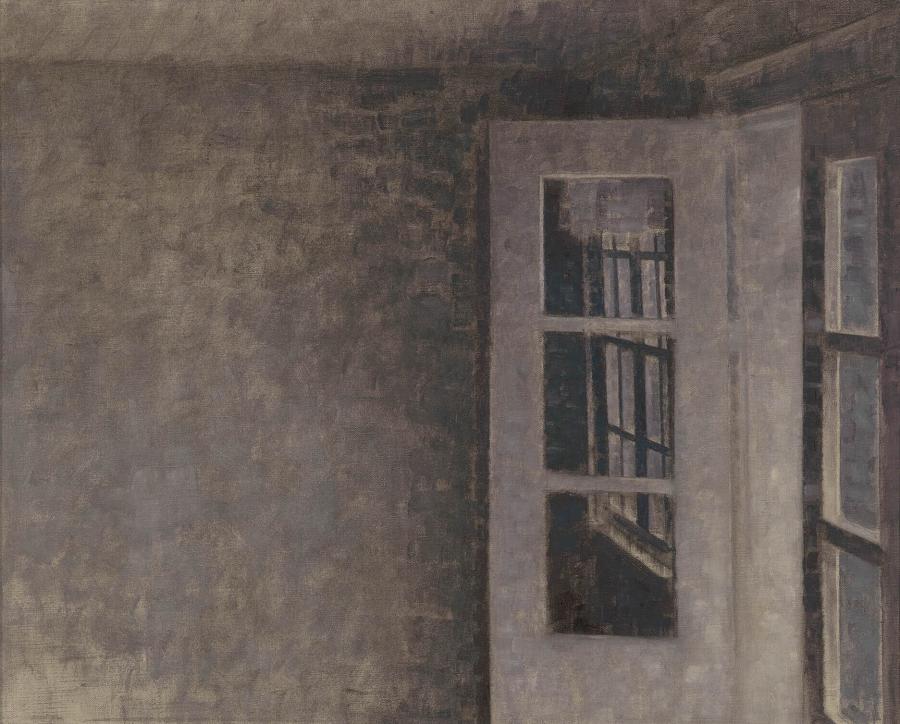
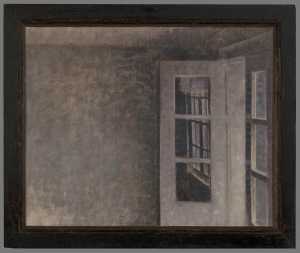
In 1911 Hamershøi rented a villa, Spurvesjkul (sparrows’ refuge) outside Copenhagen, where he spent the summer with his wife. While they were there he painted this study, which he was to use for a self-portrait. The artist travelled widely in Europe as a young man; in the Netherlands he was profoundly impressed by seventeenth-century painters like Johannes Vermeer and Pieter de Hooch.

Specifications
| Title | The Balcony Room at Spurveskjul |
|---|---|
| Material and technique | Oil on canvas |
| Object type |
Painting
> Painting
> Two-dimensional object
> Art object
|
| Location | This object is travelling |
| Dimensions |
Height 52 cm Width 61,5 cm Depth 4 cm |
|---|---|
| Artists |
Artist:
Vilhelm Hammershøi
|
| Accession number | 3750 (MK) |
| Credits | Purchased with the support of Rembrandt Association (thanks to its Maljers-De Jongh Fonds), VriendenLoterij and a donation from a private individual from Rotterdam, 2014 |
| Department | Modern Art |
| Acquisition date | 2014 |
| Creation date | in 1911 |
| Internal exhibitions |
Hammershoi en Ilsted (2016) De collectie als tijdmachine (2017) Lievelingen (2024) |
| External exhibitions |
TEFAF 2017 (2017) Vilhelm Hammershøi (2022) Face-to-Face with Images (2017) Hammershøi. The Eye that Listens (2026) Museum Boijmans Van Beuningen @ Rijksmuseum (2023) Vilhelm Hammershøi The Eye That Listens (2026) |
| Material | |
| Object |