:host { --enviso-primary-color: #FF8A21; --enviso-secondary-color: #FF8A21; font-family: 'boijmans-font', Arial, Helvetica,sans-serif; } .enviso-basket-button-wrapper { position: relative; top: 5px; } .enviso-btn { font-size: 22px; } .enviso-basket-button-items-amount { font-size: 12px; line-height: 1; background: #F18700; color: white; border-radius: 50%; width: 24px; height: 24px; min-width: 0; display: flex; align-items: center; justify-content: center; text-align: center; font-weight: bold; padding: 0; top: -13px; right: -12px; } .enviso-dialog-content { overflow: auto; } Previous Next Facebook Instagram Twitter Pinterest Tiktok Linkedin Back to top
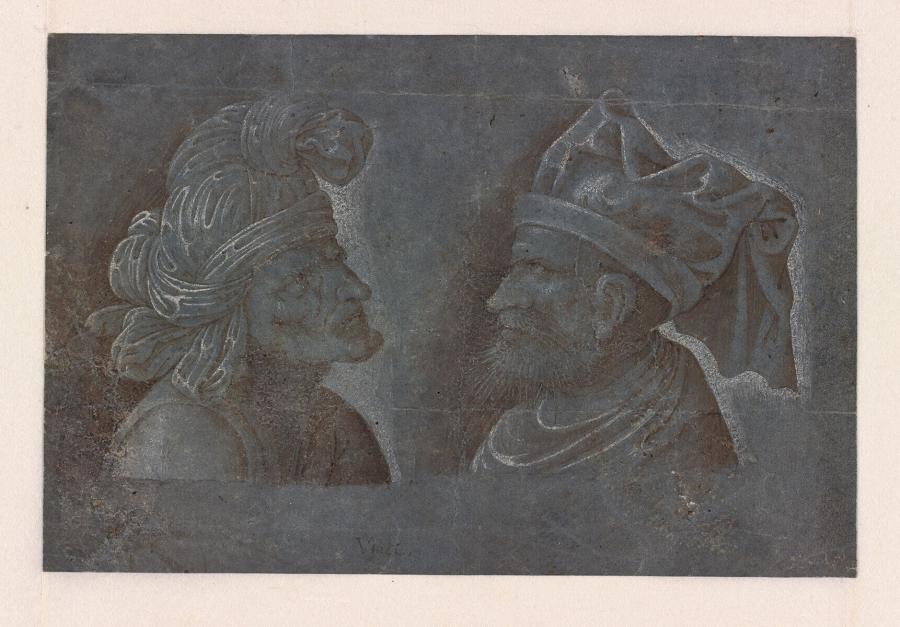
Two Male Heads

Ask anything

Loading...

Thank you. Your question has been submitted.

Unfortunately something has gone wrong while sending your question. Please try again.

Request high-res image

More information

Specifications

Title Two Male Heads
Material and technique Pen and brush and black ink, heightened with white, on grey-blue prepared paper
Object type
Drawing > Two-dimensional object > Art object
Location This object is in storage
Dimensions Height 122 mm
Width 184 mm
Artists Artist: Jacopo da Bologna
Previously attributed: Jacopo Ripanda
Accession number I 33 recto (PK)
Credits Loan Stichting Museum Boijmans Van Beuningen (former Koenigs collection), 1940
Department Drawings & Prints
Acquisition date 1940
Creation date in circa 1490-1530
Watermark not visible due to prepared ground on both sides (vV, ?P)
Inscriptions 'Vinci.' (below left centre., metalpoint), '5-' (verso, below centre, metalpoint), 'B 3764' (verso, below right centre, pencil)
Collector Collector / Franz Koenigs
Provenance Franz W. Koenigs (1881-1941, L.1023a), Haarlem, acquired in 1925 (Venetian, c. 1500); D.G. van Beuningen (1877-1955), Rotterdam, acquired with the Koenigs Collection in 1940 and donated to Stichting Museum Boijmans Van Beuningen
Research Show research Italian Drawings 1400-1600
Material
Object
Technique
Highlight > Painting technique > Technique > Material and technique
Geographical origin Italy > Southern Europe > Europe

Do you have corrections or additional information about this work? Please, send us a message

Entry catalogue Italian Drawings 1400-1600

Author: Surya Stemerding

Although these two heads are facing each other, they are separate, autonomous studies, the one on the right in profile, the other in a three-quarters pose. The high-contrast combination of shading in wash and white highlights gives the heads a sculptural appearance that is reinforced by the use of black and white around their outlines to make their contours stand out against the background. The superficial relationship to caricature heads drawn by Leonardo da Vinci (1452-1519) as indicated by the annotation ‘Vinci’ at the bottom of the sheet.

Drawings with similar male heads wearing headgear of draped or folded fabric can be found in several museums. Their relationship to the Rotterdam sheet is not only typological but technical as well. One is in Berlin, and four in Amsterdam.[1] The latter are attributed there to the Bolognese artist Jacopo Ripanda (mid-fifteenth century-after 1517) and are all in pairs in the same chiaroscuro technique and on paper prepared with a ground of blue or grey. Those heads, with exotic moustaches and beards, are more fanciful than those in Rotterdam.

In Paris there are eight sheets, each with four such drawings in a row, four with heads wearing decorated helmets and four with turbans. They are more simply executed than those mentioned above, and are in pen and brown ink, without prepared grounds.[2] The sheets in Paris and the two drawings in Rotterdam are fragments of vertical sheets on which the drawings are grouped in horizontal rows similar to the mise-en-page of the Berlin sheet.

On the back of the Rotterdam sheet, which was originally much larger, there is a scene consisting of only the legs of two figures. They are of Hercules lifting Antaeus up in their wrestling match, with a third figure beside them. Hercules’ lower body appears in reverse on the back of the drawing in Berlin, providing an added reason for assuming that both drawings are by the same artist. Faietti and Ebert-Schifferer (1988) have attributed them and the other drawings to Jacopo da Bologna, who until then had been confused with his probable teacher Jacopo Ripanda, to whom they were accordingly attributed.[3] Da Bologna is a more minor artist who is known from a model book fragment in Lille that is partly annotated ‘Jac d[…] bollogna’ with the date 1516. That book also features comparable male heads and headgear.[4] The prototypes, which are probably copies, were inspired by antique sources and works by such contemporaries as Andrea Mantegna (c.1431-1506), Ercole de’ Roberti (c.1451-1496) and Leonardo. Decorative drawings of individual figures of this kind probably served as designs for nielli, small silver plates prepared with a classical smithing technique in which the grooves of the engraved scene were filled with a black substance that then hardens. Such small engravings could also be applied to paper as prints, and the designs were even used to decorate majolica.

Footnotes

[1] Staatliche Museen, Kupferstichkabinett, inv. KdZ 4252 verso; Rijksmuseum, inv. RP-T-1959-154, 155, 156 and 157.

[2] Musée du Louvre, inv. 2642-49.

[3] See Faietti and Ebert-Schifferer in: Bologna 1988, pp. 213-36 and 237-45 respectively. See also the entries by Ebert-Schifferer, pp. 305-317, nos. 90-96; and the Rotterdam drawing inv. I 384.

[4] Musée des Beaux-Arts, inv. PI 380-397; Bologna 1988, no. 93, ill.; Elen 1995, no. 52. The drawings on the thirteen loose parchment sheets are regarded as the core of Jacopo da Bologna‘s drawn oeuvre, together with the drawings in the Louvre (nos. 94-95), due to their coherent subject matter and style.

Show research Italian Drawings 1400-1600
Show catalogue entry Hide catalogue entry

All about the artist

Jacopo da Bologna

werkzaam circa 1490 - 1530

Bekijk het volledige profiel