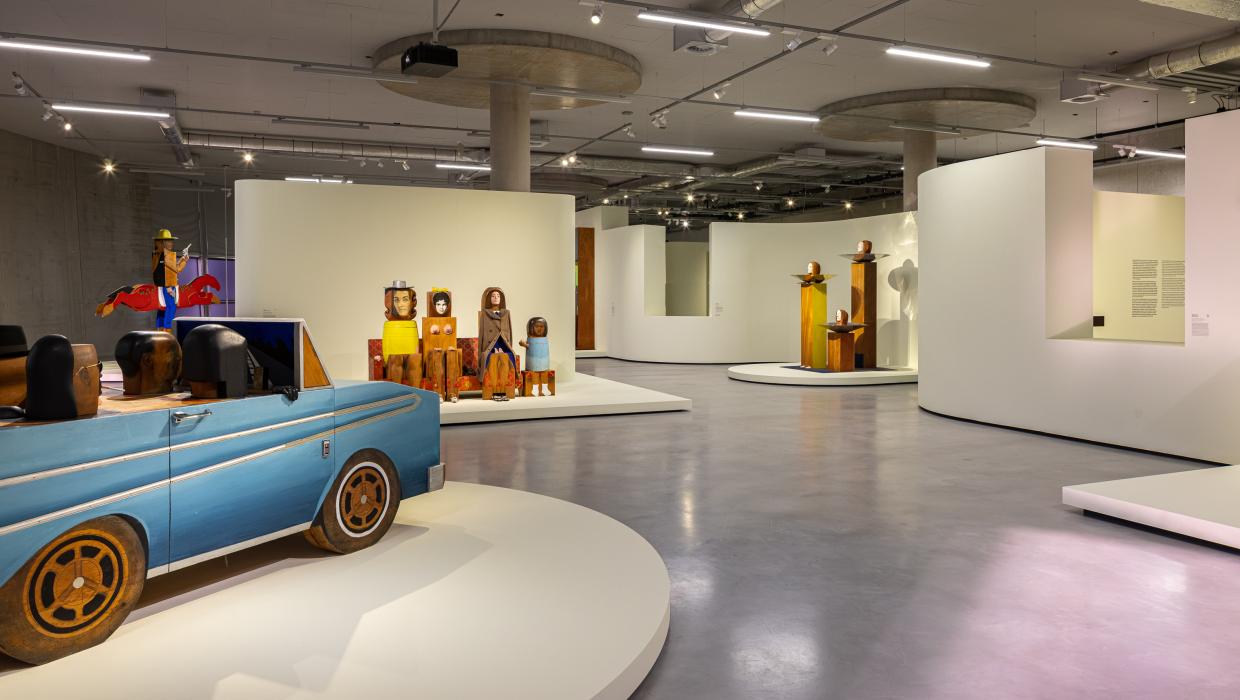
Pixel Pioneers is the first major exhibition of Museum Boijman Van Beuningen devoted entirely to digital art. Spread across two galleries in the Depot, the exhibition traces how artists have used digital technologies to experiment, critique, and reshape visual culture over the past decades.

Pixel Pioneers
Pixel Pioneers shows how artists have shaped digital visual culture - pixel by pixel.
Depot
Tuesday until Sunday
11:00 AM – 5:00 PM
Location:
- Gallery II, 4th floor
- Gallery III, 5th floor
Horizons is on show until September 20th.
Pixel Pioneers More information
At its core is Horizons (2008) by Dutch artist Geert Mul (b. 1965, NL), an interactive installation that has not been shown since its commission nearly twenty years ago. The work assembles over two hundred artworks from the museum’s collection - each containing a horizon - into a projected landscape that shifts with every movement of the visitor. Restored specifically for this presentation, Horizons raises pressing questions about the preservation of digital art, challenging the assumption that technological artworks are inherently stable. Instead, it reveals the fragility of digital systems and prompts reflection on what, exactly, should be conserved as part of a digital artwork. The second gallery builds on this collection anchor with new commissions and key works by artists who helped define digital culture. Often overlooked in mainstream art histories, these global pioneers treated technology not simply as a tool, but as a medium for aesthetic innovation, political reflection, and social engagement. Suzanne Treister (b. 1958, UK) presents works from her Hexen series, mapping hidden technological, financial, and power structures. Claudia Hart (b. 1955, US) contributes an immersive installation that reimagines failed cryptocurrencies as the ruins of a technological empire, exploring how digital systems shape belief and value. Feng Mengbo (b. 1966, CN) shows Long March: Restart, a playable video game that restages Chinese revolutionary history through the lens of retro gaming-style.
You can visit this exhibition with your Depot ticket.
TicketsThe exhibition Pixel Pioneers is made possible with the support of the VriendenLoterij, Mondriaan Fonds, Fonds 21, Stichting Museum Boijmans Van Beuningen through a contribution from the estate of Rine Coolen–Kalkman, and the Municipality of Rotterdam.