


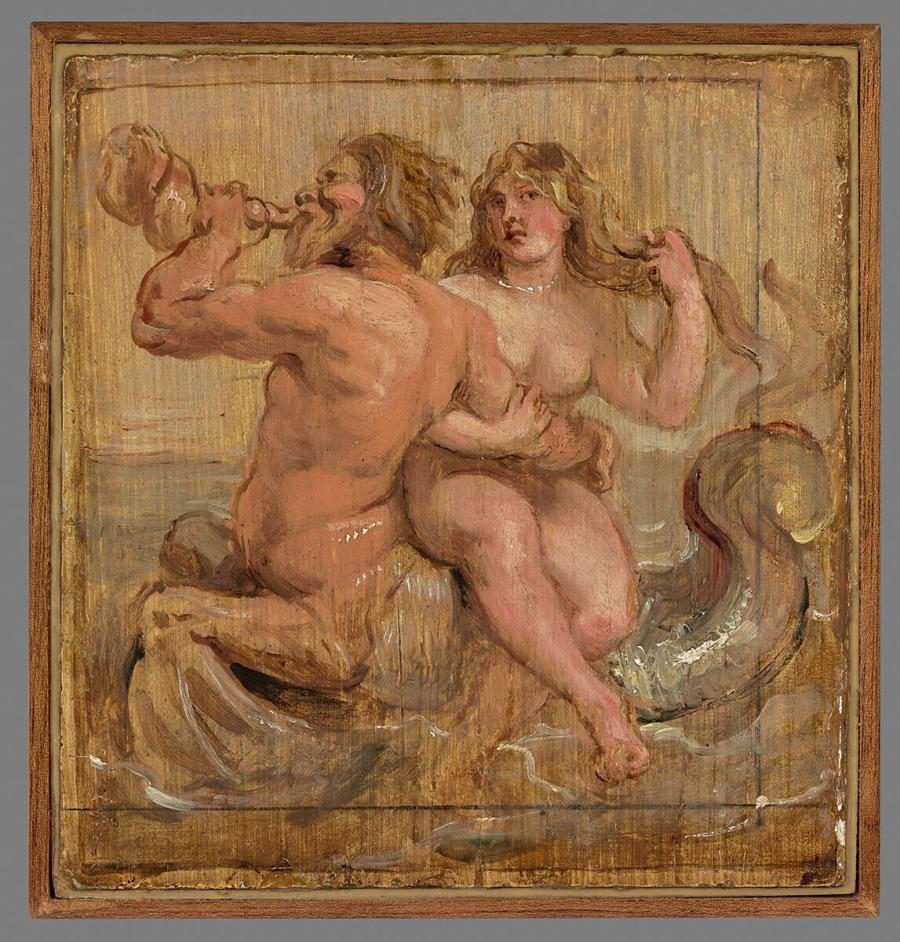
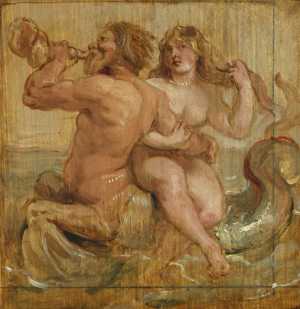
This sketch with two sea creatures does not illustrate any specific mythological story. The tritons, semi-human beings with a curled fish tail and fin-shaped ‘seahorse legs’, and their companions, the beautiful naked nereids, are lower sea gods, who are seldom absent from mythological scenes with a maritime character. They belong to the court of Neptune and are often present at the birth of Venus, a scene Rubens used for the Torre de la Parada and other assignments. The design of a nereid sitting on the back of a triton blowing a horn, is very traditional: it already appear in ancient times and there are numerous examples in renaissance art. The sketch is a design for the decoration of the Torre de la Parada hunting lodge, belonging to King Philip IV of Spain.

Specifications
| Title | Nereid and Triton |
|---|---|
| Material and technique | Oil on panel |
| Object type |
Painting
> Painting
> Two-dimensional object
> Art object
|
| Location | This object is in storage |
| Dimensions |
Width 14 cm Height 14,5 cm |
|---|---|
| Artists |
Painter:
Peter Paul Rubens
|
| Accession number | St 32 |
| Credits | Loan Stichting Museum Boijmans Van Beuningen (former Koenigs collection), 1940 |
| Department | Old Masters |
| Acquisition date | 1940 |
| Creation date | in 1636 |
| Collector | Collector / Franz Koenigs |
| Internal exhibitions |
The Collection Enriched (2011) |
| External exhibitions |
Museum Boijmans Van Beuningen @ Rijksmuseum (2023) |
| Material | |
| Object | |
| Geographical origin | Southern Netherlands > The Netherlands > Western Europe > Europe |
All about the artist
Peter Paul Rubens
Siegen 1577 - Antwerpen 1640
The Antwerp painter Peter Paul Rubens was appointed court artist to the Duke of Mantua in Italy at a young age. In 1603 he travelled to Madrid, where he was...
Bekijk het volledige profiel


