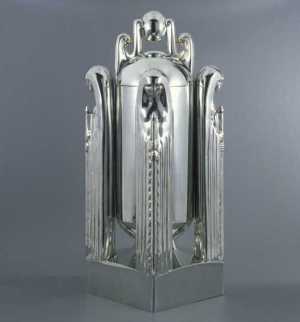
The sculptor Hendrik van den Eynde designed this urn in a style akin to the decorative, symbolist design that he used for the buildings of the Amsterdam School in the same period. Four stylised female figures, each holding a candle, stand guard around the smooth, cylindrical urn. The object was made by the firm of J.M. van Kempen, which for decades set the trend in Dutch silver design. It was shown at the Art Deco exhibition in Paris in 1925.

Specifications
| Title | urn |
|---|---|
| Material and technique | Silver, 835/000 percentage, embossing |
| Object type |
Urn
> Funerary object
> Ceremonial object
> Utensil
|
| Location | This object is in storage |
| Dimensions |
Height 60,5 cm Length 22 cm Width 22 cm |
|---|---|
| Artists |
Designer:
Hendrik Albertus van den Eijnde
Executor: J.M. van Kempen & Zn. |
| Accession number | MBZ 348 (KN&V) |
| Credits | Purchased 1982 |
| Department | Applied Arts & Design |
| Acquisition date | 1982 |
| Creation date | in 1918 |
| Material | |
| Object | |
| Technique |
Extrude
> Forced
> Shaping techniques
> Metal working technique
> Technique
> Material and technique
Extrude
> Forced
> Shaping techniques
> Metal working technique
> Technique
> Material and technique
Emboss
> Embossed
> Decorative techniques
> Metal working technique
> Technique
> Material and technique
Emboss
> Embossed
> Decorative techniques
> Metal working technique
> Technique
> Material and technique
|
| Geographical origin | The Netherlands > Western Europe > Europe |
| Place of manufacture | Voorschoten > South Holland > The Netherlands > Western Europe > Europe |
Do you have corrections or additional information about this work? Please, send us a message