

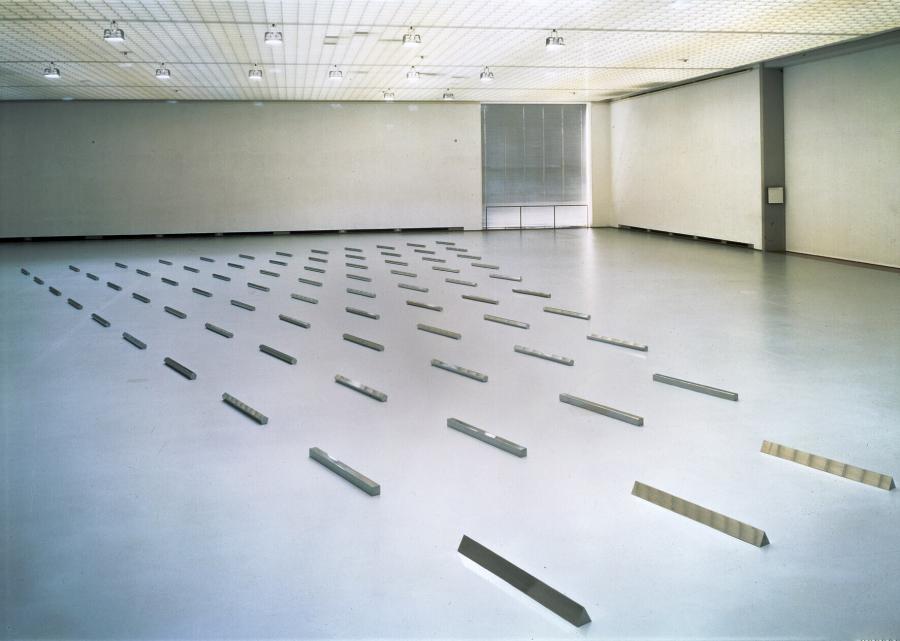
Severe in form and sparkling in the light, the 75 stainless steel rods of this floor sculpture radiate a compacted energy. In this sculpture, which was specially conceived by De Maria for the first-floor gallery in the museum, a strict order prevails. Beginning with a row of three triangular rods, the sculpture ends with one of twelve almost circular twelve-sided rods. The length of the rods determines the dimensions: there is a metre between each of the parallel rows and the succesive rows are a metre longer on one side each time. Despite this lucid, serial structure, the sculpture is of a great visual complexity and each change of viewpoint produces a new image. Not only because of this complexity, but also and above all because of the silence and concentration it emanates, this sculpture compels a contemplative approach.


Specifications
| Title | A Computer which will solve Every Problem in the World / 3-12 Polygon |
|---|---|
| Material and technique | Polished stainless steel |
| Object type |
Sculpture
> Three-dimensional object
> Art object
|
| Location | This object is in storage |
| Dimensions |
Height 19 m Width 12,5 m Depth 21,3 m |
|---|---|
| Artists |
Artist:
Walter De Maria
|
| Accession number | BEK 1603 a-d (MK) |
| Credits | Purchased 1984 |
| Department | Modern Art |
| Acquisition date | 1984 |
| Creation date | in 1984 |
| Internal exhibitions |
SHINE (2003) |
| External exhibitions |
Walter De Maria, A Computer Which Will Solve Every Problem in the World / 3-12 Polygon 1984 (2011) |
| Material | |
| Object | |
| Geographical origin | The United States of America > North America > America |