:host { --enviso-primary-color: #FF8A21; --enviso-secondary-color: #FF8A21; font-family: 'boijmans-font', Arial, Helvetica,sans-serif; } .enviso-basket-button-wrapper { position: relative; top: 5px; } .enviso-btn { font-size: 22px; } .enviso-basket-button-items-amount { font-size: 12px; line-height: 1; background: #F18700; color: white; border-radius: 50%; width: 24px; height: 24px; min-width: 0; display: flex; align-items: center; justify-content: center; text-align: center; font-weight: bold; padding: 0; top: -13px; right: -12px; } .enviso-dialog-content { overflow: auto; } Previous Next Facebook Instagram Twitter Pinterest Tiktok Linkedin Back to top
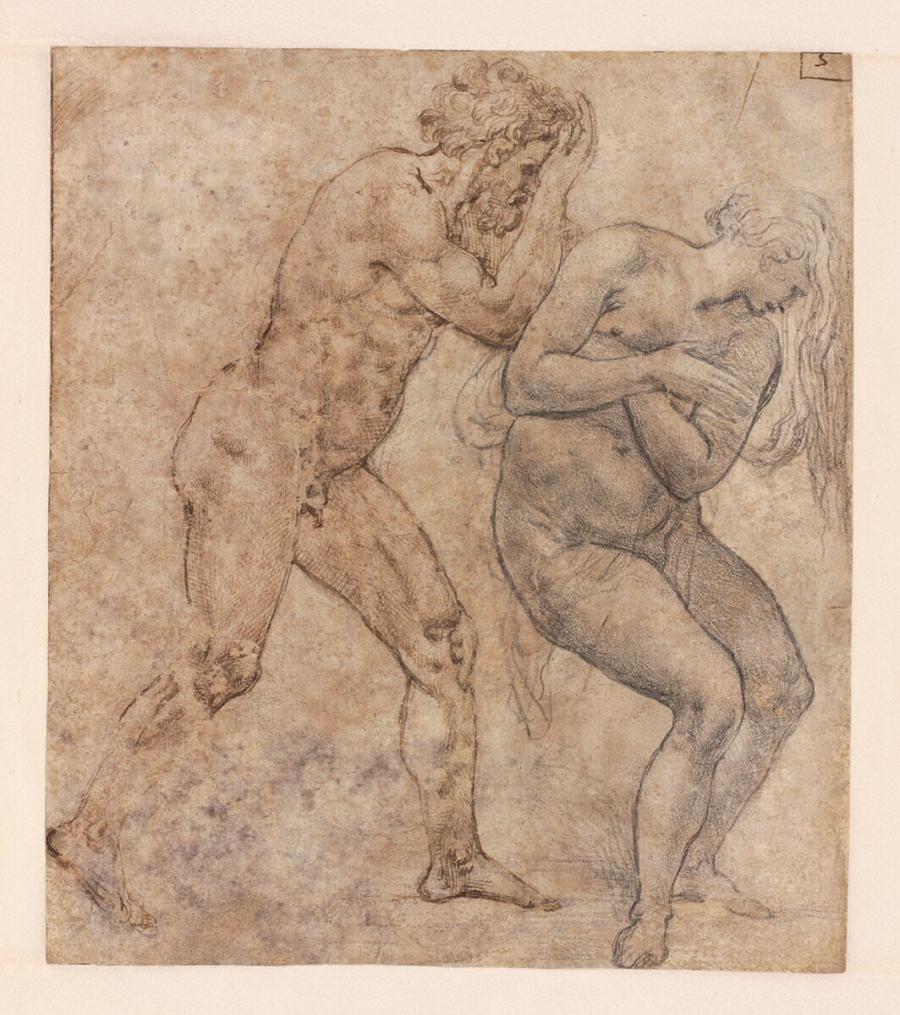
Nude Man and Woman

Nude Man and Woman

Anoniem (in circa 1550-1650)

Ask anything

Loading...

Thank you. Your question has been submitted.

Unfortunately something has gone wrong while sending your question. Please try again.

Request high-res image

More information

Specifications

Title Nude Man and Woman
Material and technique Pen and brown ink, black chalk
Object type
Drawing > Two-dimensional object > Art object
Location This object is in storage
Dimensions Height 241 mm
Width 208 mm
Artists Draughtsman: Anoniem
Accession number I 507 recto (PK)
Credits Loan Stichting Museum Boijmans Van Beuningen (former Koenigs collection), 1940
Department Drawings & Prints
Acquisition date 1940
Creation date in circa 1550-1650
Inscriptions “5” [or 3?]” (recto, lower right, pen and ink)
Collector Collector / Franz Koenigs
Provenance Franz W. Koenigs (1881-1941, L.1023a), Haarlem, acquired in 1920-1930 (Roman, 16th century); D.G. van Beuningen (1877-1955), Rotterdam, acquired with the Koenigs Collection in 1940 and donated to Stichting Museum Boijmans Van Beuningen
Research Show research Italian Drawings 1400-1600
Material
Object
Geographical origin Italy > Southern Europe > Europe
Place of manufacture Rome > Italy > Southern Europe > Europe

Do you have corrections or additional information about this work? Please, send us a message

Entry catalogue Italian Drawings 1400-1600

Author: Klazina Botke

Two nude figures are drawn side by side, both looking down. The man is depicted in pen and ink, with fine hatching and strongly emphasized outlines. He appears to be walking forward and holds his hands over his face. The woman to his right is set down with black chalk and similarly strong outlines. She stands still and tries to cover her breast with her crossed arms. The position of the man is very reminiscent of Adam in the fresco The Expulsion from the Garden of Eden (c.1425) by Masaccio (1401-1428). This famous work in the Brancacci Chapel in Florence served as an example for many other illustrations of this Bible story.[1] In the Vatican loggia in the Apostolic Palace, The Expulsion (c.1518-19) is depicted in a similar manner by the workshop of Raphael (1483-1520). Here, too, Adam steps forward on his right foot and holds his hands over his face in shame and despair. The female figure in our drawing, however, does not correspond to Masaccio’s or Raphael’s Eve. The position of her body is so unnatural that one might well think that she has been copied from a seated figure. The way her legs are positioned is very like that of Susannah in the print by Christoffel Jagher (1596-1652/1653), after a painting by Peter Paul Rubens (1577-1640).[2] As the woman was drawn in a different technique, it is likely that she was added to the sheet later.

On the verso stands a soldier with a staff in his right hand. Hugo Chapman was the first to suggest that this figure was based on one of the Roman soldiers in the centre of Michelangelo’s (1475-1564) Crucifixion of St Peter (c.1542-49).[3] The position of the arms and the clothes differ slightly, but the rest of the figure corresponds reasonably well. At the upper left, the head of a second figure was drawn in brush and on the right there are three lightly drawn pen-and-ink studies of a window or architectural frame.

The handwritten number in a box in the upper right corner of the recto suggests that this may be a folio from a drawing book.[4] Starting in the fifteenth century, there was a strong tradition of drawing copies of the work of great masters, Michelangelo and Raphael among them, in order to practise and thus become a better artist.[5] Both Adam and the soldier are based on frescoes in the Apostolic Palace, the pope’s residence and office. These paintings were issued as prints as early as the end of the sixteenth century. It is therefore quite possible that the anonymous draughtsman used these prints, rather than the actual paintings, as his source.[6]

Footnotes

[1] Genesis 3:24.

[2] Amsterdam, Rijksmuseum, inv. RP-P-OB-39.799; Hollstein Dutch 1-1(2). 

[3] Comment during an online expert meeting, 9 October 2020. Michelangelo’s fresco was painted in the Cappella Paolina (the Pauline Chapel), which precedes the Sistine Chapel in the Apostolic Palace in Vatican City.

[4] This suggestion comes from Albert Elen, 1 August 2018.

[5] The use of profile and the tight outlines could indicate that the draughtsman was a sculptor or a designer of stucco. This was observed by Furio Rinaldi during an online expert meeting, 9 October 2020.

[6] See e.g. London, British Museum, inv. V,4.21 and V,2.48.  

Show research Italian Drawings 1400-1600
Show catalogue entry Hide catalogue entry

All about the artist