:host { --enviso-primary-color: #FF8A21; --enviso-secondary-color: #FF8A21; font-family: 'boijmans-font', Arial, Helvetica,sans-serif; } .enviso-basket-button-wrapper { position: relative; top: 5px; } .enviso-btn { font-size: 22px; } .enviso-basket-button-items-amount { font-size: 12px; line-height: 1; background: #F18700; color: white; border-radius: 50%; width: 24px; height: 24px; min-width: 0; display: flex; align-items: center; justify-content: center; text-align: center; font-weight: bold; padding: 0; top: -13px; right: -12px; } .enviso-dialog-content { overflow: auto; } Previous Next Facebook Instagram Twitter Pinterest Tiktok Linkedin Back to top
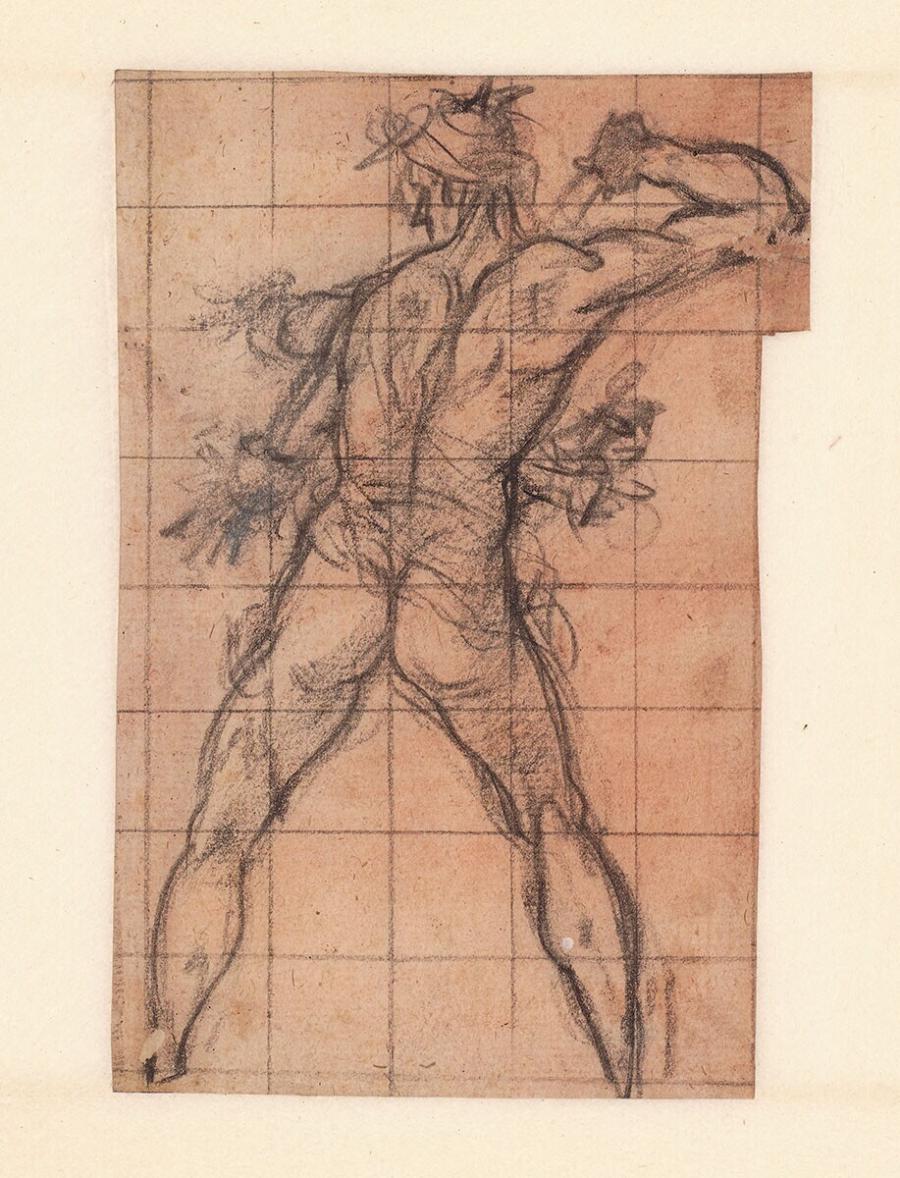
A Figure for the Flagellation of Christ

A Figure for the Flagellation of Christ

Alessandro di Vincenzio Fei (in circa 1575)

Ask anything

Loading...

Thank you. Your question has been submitted.

Unfortunately something has gone wrong while sending your question. Please try again.

Request high-res image

More information

Specifications

Title A Figure for the Flagellation of Christ
Material and technique Black chalk, squared, on pink prepared paper (recto and verso)
Object type
Drawing > Two-dimensional object > Art object
Location This object is in storage
Dimensions Height 131 mm
Width 89 mm
Artists : Alessandro di Vincenzio Fei
: Lorenzo Rustici (Lorenzo di Cristoforo Brazzi)
Accession number I 537 (PK)
Credits Loan Stichting Museum Boijmans Van Beuningen (former Koenigs collection), 1940
Department Drawings & Prints
Acquisition date 1940
Creation date in circa 1575
Watermark something? in a circle (39 x 22 mm, upper right on P3 of 3P, vH)
Collector Collector / Franz Koenigs
Mark (?) S. Landsinger (L.2358), F.W. Koenigs (L.1023a)
Provenance Sigmund Landsinger (1855-1928, L.2358)****, Munich; Art dealer Julius W. Böhler (1883-1966), Lucerne; Franz W. Koenigs (1881-1941, L.1023a), Haarlem, acquired in 1929 (Rustico); D.G. van Beuningen (1877-1955), Rotterdam, acquired with the Koenigs Collection in 1940 and donated to Stichting Museum Boijmans Van Beuningen
Exhibitions Rotterdam 2009 (coll 2 kw 3)
Internal exhibitions De Collectie Twee - wissel III, Prenten & Tekeningen (2009)
Research Show research Italian Drawings 1400-1600
Literature Loeser 1928, p. 272, pl. IIa (G. Rustici); Hall 1979, pp. 75-6, 128-29, pl. 85 (A. del Barbiere)
Material
Object
Technique
Prepare > Prepared > Shaping techniques > General technique > Technique > Material and technique
Squared > Squaring > Drawing technique > Technique > Material and technique
Geographical origin Italy > Southern Europe > Europe

Do you have corrections or additional information about this work? Please, send us a message
Entry catalogue Italian Drawings 1400-1600

Author: Alicia Rojas Costa

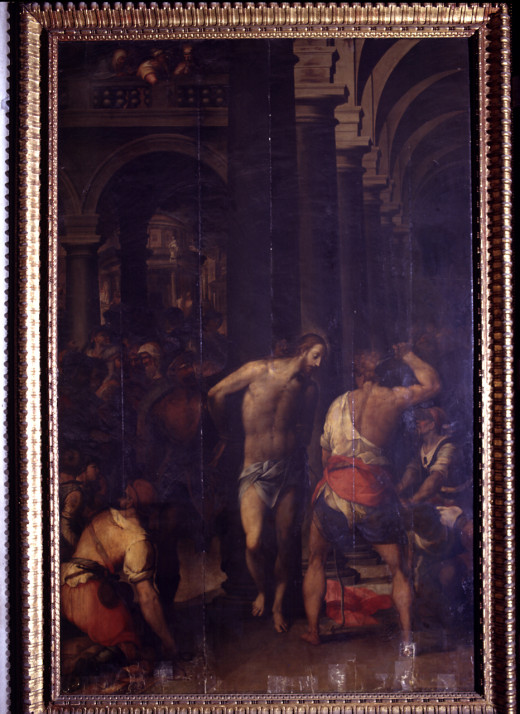
Alessandro del Barbiere, 'Flagellation of Christ', 1575, oil on panel, Florence, Santa Croce. Photo Catalogo generale dei Beni Culturali

This black chalk drawing is a study for one of the figures in the Flagellation of Christ (fig.), made by the Florentine artist Alessandro Fei (known as Barbiere) for the altarpiece of the Corsi Chapel in Santa Croce in Florence. This altarpiece, signed and dated 1575, stands as one of Barbiere’s best contributions for the decoration of this church. He accepted the commission as part of Giorgio Vasari’s (1511-1574) renovation, which involved a new iconographic programme for both the Corsi and Pazzi Chapels in Santa Croce.[1]

Influenced by the work of Sebastiano del Piombo (c.1485-1547), Barbiere based his Flagellation composition, and particularly his figure of Christ, on Del Piombo’s fresco in San Pietro in Montorio, Rome.[2] He probably became familiar with these frescoes when he was working in Rome in 1571, assisting Vasari on the chapels in the Vatican. Nonetheless, the central figure of the Rotterdam study – the flagellator at the right of Christ – is based on a different visual source. As pointed out by Hall in 1979, this figure was inspired by Andrea del Sarto (1486-1530) and his fresco of the beheading of John the Baptist at the Chiostro dello Scalzo in Florence.[3] Both figures are seen from behind, half-naked, with a vigorous physical nature.

There is another study for the entire composition of the Flagellation made by Alessandro Barbiere in Paris[4] which showcases, once more, the immense influence Del Sarto had on him. In this case, Barbiere exercised the use of red chalk in a highly similar manner to the sketches of the Florentine master.[5] The fame he gained with his altarpiece for the Corsi Chapel was such that he subsequently made numerous variants.[6]

Although Charles Loeser ascribed the Rotterdam sheet in 1928 to the hand of Gianfrancesco Rustici (1474/1475-1554),[7] the drawing contains all of Barbiere’s artistic principles. As can also be observed in another study by him in Florence, his drawing style is characterized by an intensity of the outlines over the interior contours and a schematization of the forms.[8] Moreover, pentimenti are a constant in his work, such as those observed in the flagellator’s left hand in the Rotterdam drawing.[9] Compared to the final altarpiece, small differences can be noticed. In the study, for example, the flagellator is naked and wearing a helmet, while in the final painting he is clothed but his head uncovered. The drawing has been squared to ease the transfer process.

Footnotes

[1] Hall 1979, pp. 128-29.

[2] Ibidem.

[3] Ibidem.

[4] Musée du Louvre, inv. 198.

[5] Hall 1979, p. 75.

[6] For example, a version sold at Sotheby’s, New York, 29 January 2021, lot 114.

[7] Loeser 1928, p. 272.

[8] Gallerie degli Uffizi, inv. 6436 F.

[9] Hall 1979, p. 129.

Show research Italian Drawings 1400-1600
Show catalogue entry Hide catalogue entry

All about the artist

Alessandro di Vincenzio Fei

Florence 1543 - Florence 1592

Bekijk het volledige profiel