:host { --enviso-primary-color: #FF8A21; --enviso-secondary-color: #FF8A21; font-family: 'boijmans-font', Arial, Helvetica,sans-serif; } .enviso-basket-button-wrapper { position: relative; top: 5px; } .enviso-btn { font-size: 22px; } .enviso-basket-button-items-amount { font-size: 12px; line-height: 1; background: #F18700; color: white; border-radius: 50%; width: 24px; height: 24px; min-width: 0; display: flex; align-items: center; justify-content: center; text-align: center; font-weight: bold; padding: 0; top: -13px; right: -12px; } .enviso-dialog-content { overflow: auto; } Previous Next Facebook Instagram Twitter Pinterest Tiktok Linkedin Back to top
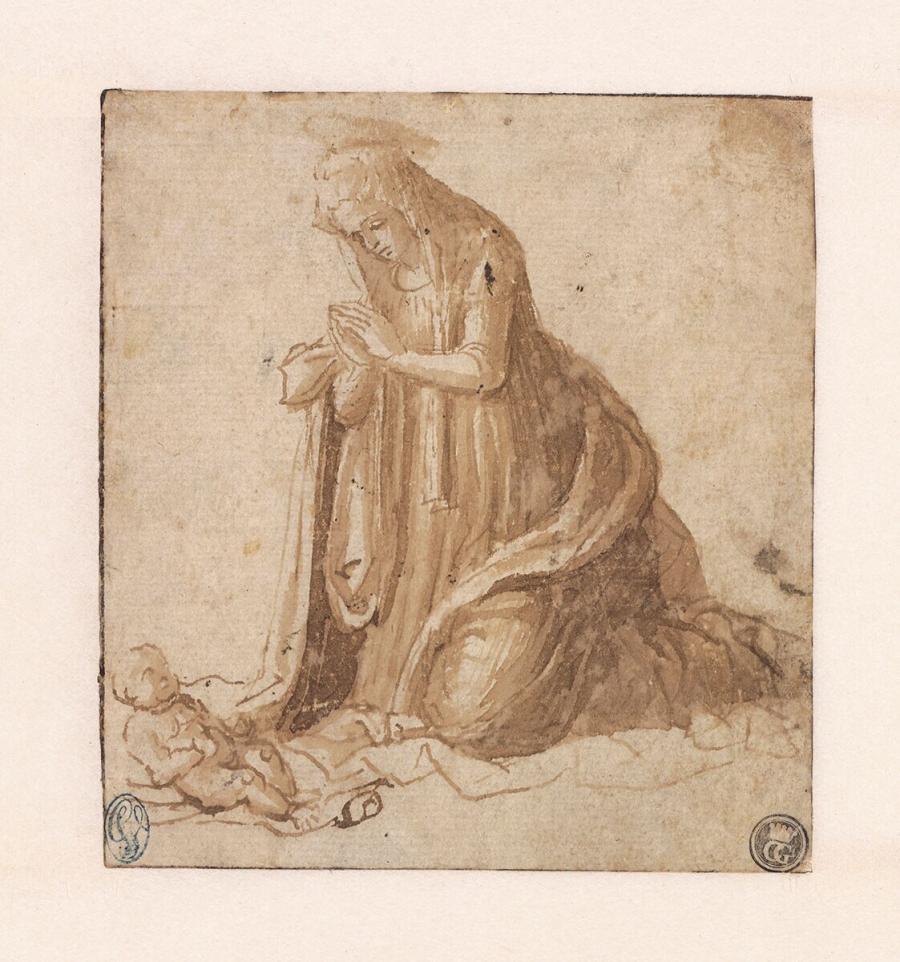
Adoration of the Christ Child

Adoration of the Christ Child

Anoniem (in circa 1500-1550)

Ask anything

Loading...

Thank you. Your question has been submitted.

Unfortunately something has gone wrong while sending your question. Please try again.

Request high-res image

More information

Specifications

Title Adoration of the Christ Child
Material and technique Pen and brown ink, brown wash
Object type
Drawing > Two-dimensional object > Art object
Location This object is in storage
Dimensions Height 109 mm
Width 100 mm
Artists Draughtsman: Anoniem
Accession number I 192 (PK)
Credits Loan Stichting Museum Boijmans Van Beuningen (former Koenigs collection), 1940
Department Drawings & Prints
Acquisition date 1940
Creation date in circa 1500-1550
Watermark none (vH, 3P, fijn papier)
Inscriptions 'Costa' (on old mount, lower right, pencil), ‘11' (on old mount, below centre, pencil?), '55' (on old mount, lower left, pencil), 'G.60' (on old mount, upper right, red chalk)
Collector Collector / Franz Koenigs
Mark M.I.B.G. Genevosio (L.545 on old mount), G. Vallardi (L.1223, no. G.60 on onld mount), Count G. Strogonoff (L.550), F.W. Koenigs (L.1023a) on old mount
Provenance Modesto I.B.G. Genevosio (1719-1795, L.545), Turin; (?) with the drawings coll. sold on 28.03.1794 to Marchese Giovanni Turinetti di Priero, Turin; Giuseppe Vallardi (1784-1863, L.1223/1223a)**, art dealer, Milan, his no. G 60; Count Grégoire Stroganoff (1829-1910, L.550), Rome; his sale, Rome (Jandolo, Tavazzi) 18-23.04.1910; Franz W. Koenigs (1881-1941, L.1023a), Haarlem, acquired in 1920-30 (Italian, second half 15th century); D.G. van Beuningen (1877-1955), Rotterdam, acquired with the Koenigs Collection in 1940 and donated to Stichting Museum Boijmans Van Beuningen
Exhibitions Amsterdam 1934, no. 457 (North Italian, 2nd half 15th C.)
Research Show research Italian Drawings 1400-1600
Literature Amsterdam 1934, no. 457 (North Italian, 2nd half 15th C.)
Material
Object
Technique
Brown wash > Washing > Wash > Drawing technique > Technique > Material and technique
Geographical origin Italy > Southern Europe > Europe

Do you have corrections or additional information about this work? Please, send us a message

Entry catalogue Italian Drawings 1400-1600

Author: Klazina Botke

In this drawing Mary has her hands joined in prayer as she looks down on the Christ Child lying on her cloak. The event is not recorded in the gospels but was borrowed from a fourteenth-century vision granted to St Bridget of Sweden (1303-1373), in which she was a witness at the Nativity and saw the Virgin kneeling in adoration of the newborn baby. ‘But yet, at once, I saw that glorious infant lying on the earth, naked and glowing in the greatest of neatness. His flesh was most clean of all filth and uncleanness. I saw also the afterbirth, lying wrapped very neatly beside him. And then I heard the wonderfully sweet and most dulcet songs of the angels. And the Virgin's womb, which before the birth had been very swollen, at once retracted; and her body then looked wonderfully beautiful and delicate. When therefore the Virgin felt that she had now given birth, at once, having bowed her head and joined her hands, with great dignity and reverence she adored the boy and said to him: "Welcome, my God, my Lord, and my Son!".'[1]

The scene was popular in Italy at the end of the fifteenth century. A print by Andrea Mantegna (1430/31-1506), in which the Virgin is seated on the ground and lovingly holding the Child, shaped the evolution of the genre.[2] Certain stylistic elements of the Rotterdam drawing look Venetian, and may have been borrowed from the work of Cima da Conegliano (1459/1460-1517/1518) or Vittore Carpaccio (ca. 1460/1465-1525/1526).[3] That makes it likely that our study was made in Venice at the beginning of the sixteenth century.

Two collectors’ marks are clearly visible at the bottom of the sheet: on the left the stamp of the art dealer Giuseppe Vallardi (1784-1861) and on the right that of the collector Count Grégoire Stroganoff (1829-1910). Vallardi used a stamp with the letters ‘GV’ in order to mark drawings that he sold, many of which have a letter followed by a number in red chalk. The backing sheet removed from this drawing was marked ‘G. 60’. The meaning of these annotations is still not entirely certain, but it could be a portfolio letter followed by a serial number.[4] There is a similar notation on the recto verso of another drawing in Museum Boijmans Van Beuningen that is attributed to the workshop of Filippo Lippi (c.1406-1469) (I 493).[5]  

Footnotes

[1] Translated here from Birgitta van Zweden, bk. VII, p. 21.

[2] London, British Museum, inv. 1856,0712.1072. Phillip Pouncey also assumed that this must have been a model for the present sheet. See the remark on the old mount.

[3] According to Giada Damen and Gert Jan van der Sman respectively, although opinions differed about these similarities at an online expert meeting on 10 September 2020.

[4] See Lugt Online, no. 1223.

[5] Museum Boijmans Van Beuningen, inv. I 493; this drawing also has Giuseppe Vallardi’s mark L.1223a.

Show research Italian Drawings 1400-1600
Show catalogue entry Hide catalogue entry

All about the artist