:host { --enviso-primary-color: #FF8A21; --enviso-secondary-color: #FF8A21; font-family: 'boijmans-font', Arial, Helvetica,sans-serif; } .enviso-basket-button-wrapper { position: relative; top: 5px; } .enviso-btn { font-size: 22px; } .enviso-basket-button-items-amount { font-size: 12px; line-height: 1; background: #F18700; color: white; border-radius: 50%; width: 24px; height: 24px; min-width: 0; display: flex; align-items: center; justify-content: center; text-align: center; font-weight: bold; padding: 0; top: -13px; right: -12px; } .enviso-dialog-content { overflow: auto; } Previous Next Facebook Instagram Twitter Pinterest Tiktok Linkedin Back to top
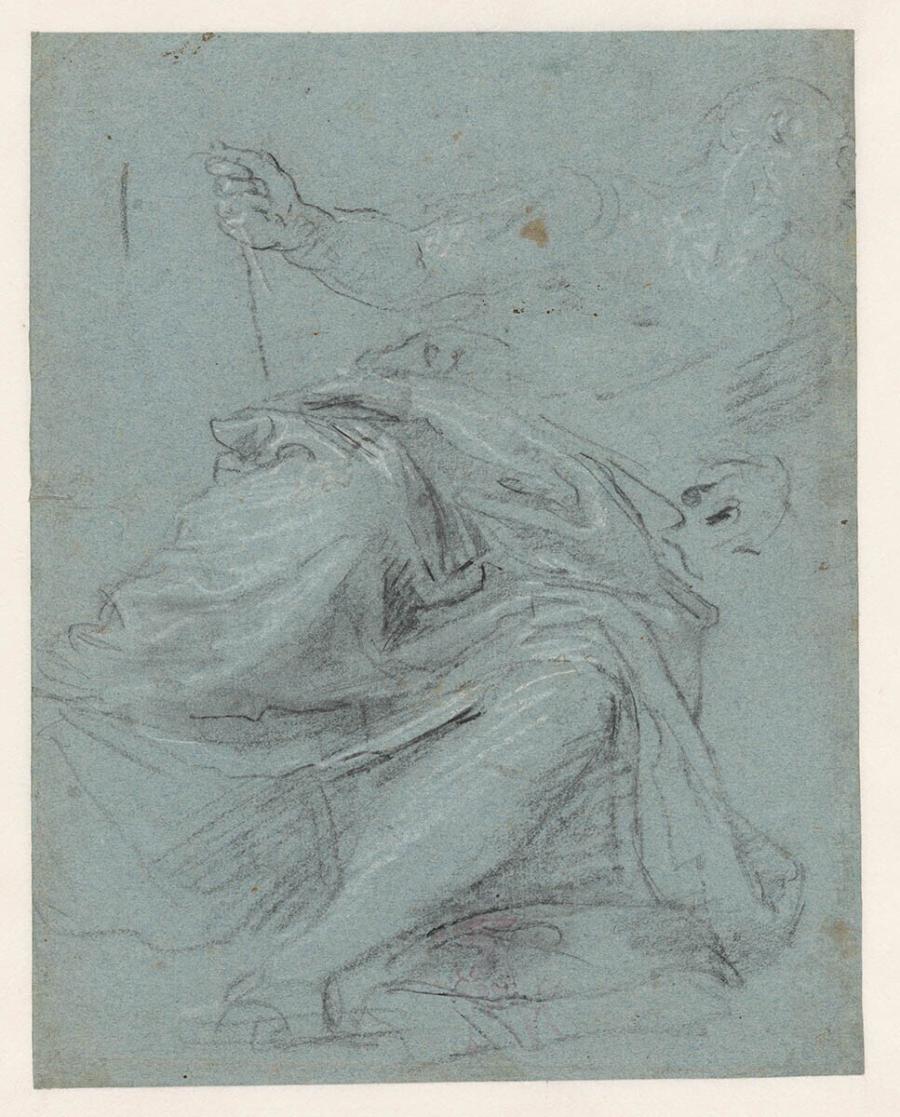
Study for a Seated Figure

Ask anything

Loading...

Thank you. Your question has been submitted.

Unfortunately something has gone wrong while sending your question. Please try again.

Request high-res image

More information

Specifications

Title Study for a Seated Figure
Material and technique Black chalk or charcoal, heightened with white, on blue paper
Object type
Drawing > Two-dimensional object > Art object
Location This object is in storage
Dimensions Height 266 mm
Width 210 mm
Artists Draughtsman: Paolo Veronese (Paolo Caliari)
Accession number I 95 (PK)
Credits Loan Stichting Museum Boijmans Van Beuningen (former Koenigs collection), 1940
Department Drawings & Prints
Acquisition date 1940
Creation date in circa 1575
Watermark none (vV, 7P)
Inscriptions '134' (verso, centre, pen and brown ink)
Collector Collector / Franz Koenigs
Mark Z. Sagredo (L.2103a, inv. 'P=no: 61', on removed backing sheet), F.W. Koenigs (L.1023a on removed backing sheet)
Provenance Zaccaria Sagredo (1653-1729, L.2103a, inv. 'P. no: 61'), Venice; - ; Franz W. Koenigs (1881-1941, L.1023a), Haarlem, acquired in 1927; D.G. van Beuningen (1877-1955), Rotterdam, acquired with the Koenigs Collection in 1940 and donated to Stichting Museum Boijmans Van Beuningen
Exhibitions Amsterdam 1934, no. 697; Amsterdam 1953, no. T 70; Venice 1988, no. 22; Rotterdam 2009-2010 (coll 2 kw 5)
Internal exhibitions De Collectie Twee - wissel V, Prenten & Tekeningen (2009)
Research Show research Italian Drawings 1400-1600
Literature Amsterdam 1934, no. 697; Tietze/Tietze-Conrat 1944, vol. 1, no. 2080 (attr. Veronese); Amsterdam 1953, no. T 70; Cocke 1984, no. 215 (rejected attr.); Venice 1988, no. 22; Washington 1988, p. 117, under no. 59; Paris 1993a, p. 590, under no. 244; Pignatti/Pedrocco 1995, vol. 2, pp. 340, 342, under no. 222; Paris 1996, p. 37, under no. 55; Berge-Gerbaud 1996, pp. 145-46, fig. 7; Rearick 2001, p. 165; Rosand/Frank 2023, p. 292, fig. 11.11
Material
Object
Technique
Highlight > Painting technique > Technique > Material and technique
Geographical origin Italy > Southern Europe > Europe
Place of manufacture Venice > Veneto region > Italy > Southern Europe > Europe

Do you have corrections or additional information about this work? Please, send us a message

Entry catalogue Italian Drawings 1400-1600

Author: Sarah Vowles

Leaning to one side, resting on one elbow with the right arm outstretched, this figure is a preparatory study for Vigilance, one of the allegories Veronese painted in the lateral portions of the ceiling of the Sala del Collegio in the Palazzo Ducale in Venice between 1575 and 1576. These representations of virtue were part of an ambitious iconographic scheme, along with three large allegorical canvases and six monochrome paintings of historical scenes, which presented an ideal vision of Venetian government.[1] Three other preparatory drawings survive for these allegories: a study for Moderation is in London,[2] and others for Industry and Chastity are in Paris.[3]

The attribution of this drawing to Paolo Veronese has not always been accepted. It was merely ‘ascribed’ to him by Tietze/Tietze-Conrat and rejected by Cocke,[4] but more recent scholarship has recognized its confident dynamism, and acknowledged it as a work by the hand of the master himself.[5] The emphasis is on the drapery, which crumples in the lap of the leaning figure; the folded cloth conveys the weight and structure of the body hidden beneath it. One can already see in the drawing the hint of the rope that Vigilance holds in her outstretched hand.

This must have been drawn early in the developmental process, given the freedom of Veronese’s touch in blocking out the figure, and adding the vivacious highlights of white chalk on legs, arm and neck. There are differences between the study for Vigilance and the way the figure appears in the final painting, but this simply underlines Veronese’s habit of developing and refining a figure, right up to the moment it was painted. In the picture, Vigilance is twisted further to the left; the right leg is raised rather than the left; the right arm is less tightly bent, but, nevertheless, the essence of the figure remains the same. Similar differences exist between the other preparatory drawings and their related paintings; indeed, the figure of Industry is entirely reversed in the painting.

Like many of the other Veronese drawings in Rotterdam, this was formerly in the Sagredo Collection and bears the inventory number of that collection in brown ink on the verso.

Footnotes

[1] Gisolfi 2017, pp. 161-65.

[2] British Museum, inv. 1969,0412.4.

[3] Fondation Custodia, inv. 1994-T.10; Musée du Louvre, inv. RF 38931.

[4] Tietze/Tietze-Conrat 1944, no. 2080; Cocke 1984, no. 215.

[5] Rearick in: Venice 1988, no. 22; Gisolfi, op.cit., p. 165.

Show research Italian Drawings 1400-1600
Show catalogue entry Hide catalogue entry

All about the artist

Paolo Veronese (Paolo Caliari)

Verona 1528 - Venetië 1588

Paolo Veronese was specialised in large biblical, allegorical and historical scenes. Veronese's choice of subject allowed him to fill his paintings with...

Bekijk het volledige profiel