:host { --enviso-primary-color: #FF8A21; --enviso-secondary-color: #FF8A21; font-family: 'boijmans-font', Arial, Helvetica,sans-serif; } .enviso-basket-button-wrapper { position: relative; top: 5px; } .enviso-btn { font-size: 22px; } .enviso-basket-button-items-amount { font-size: 12px; line-height: 1; background: #F18700; color: white; border-radius: 50%; width: 24px; height: 24px; min-width: 0; display: flex; align-items: center; justify-content: center; text-align: center; font-weight: bold; padding: 0; top: -13px; right: -12px; } .enviso-dialog-content { overflow: auto; } Previous Next Facebook Instagram Twitter Pinterest Tiktok Linkedin Back to top
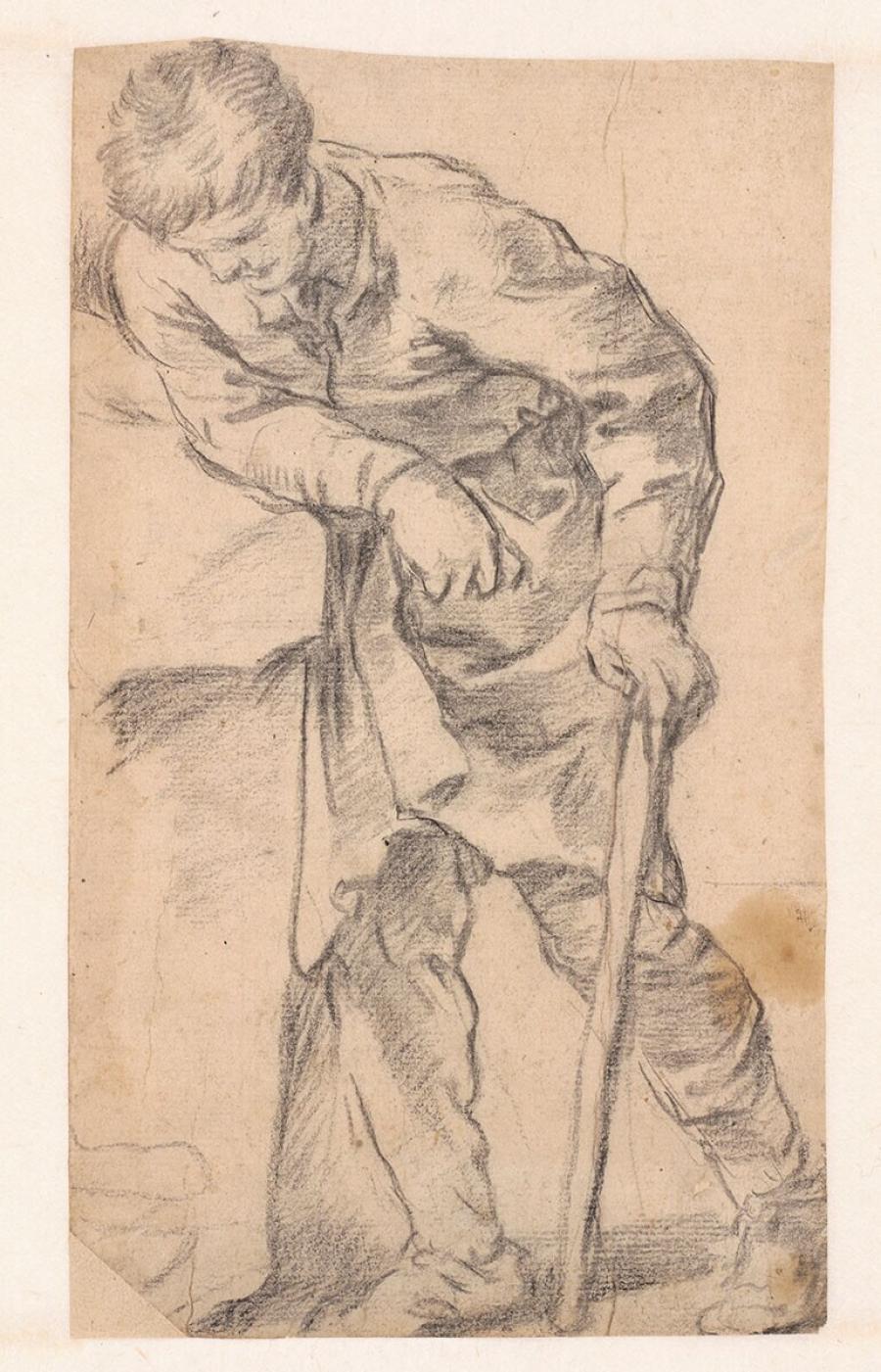
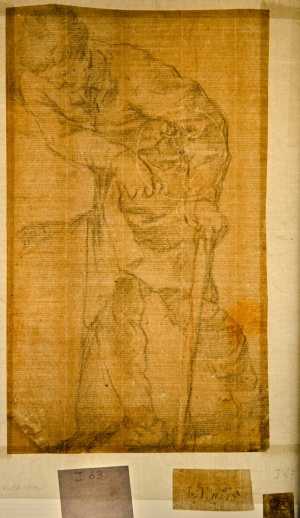
Man Leaning on a Stick

Ask anything

Loading...

Thank you. Your question has been submitted.

Unfortunately something has gone wrong while sending your question. Please try again.

Request high-res image

More information

Specifications

Title Man Leaning on a Stick
Material and technique Black chalk
Object type
Drawing > Two-dimensional object > Art object
Location This object is in storage
Dimensions Height 214 mm
Width 126 mm
Artists Previously attributed: Jacopo Tintoretto (Jacopo Comin, Jacopo Robusti)
Draughtsman: Anoniem
Accession number I 63 (PK)
Credits Loan Stichting Museum Boijmans Van Beuningen (former Koenigs collection), 1940
Department Drawings & Prints
Acquisition date 1940
Creation date in circa 1566-1700
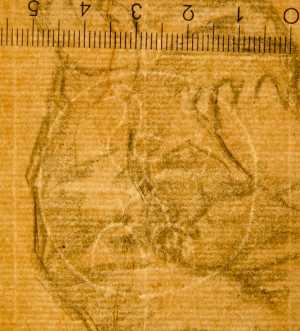
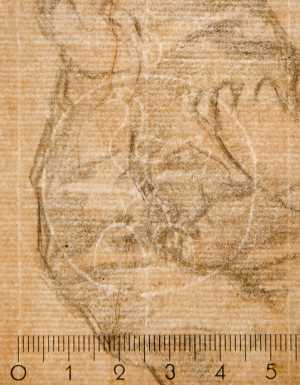
Watermark Bird (walking) on three mounts in a circle, with something on top (diam. 43 mm, at top right, upside-down, on P4 of 5P, vH), similar to Briquet 12250 (Rome, 1566-75) [see image]
Collector Collector / Franz Koenigs
Mark Z. Sagredo (L.2103a) inv. I.T. no: 15, F.W. Koenigs (L.1023a), both on fragments of removed backing sheet
Provenance Zaccaria Sagredo (1653-1729, L.2103a, inv. 'I.T. no: 15'), Venice; - ; Franz W. Koenigs (1881-1941, L.1023a), Haarlem, acquired in 1927 (Venetian, second half 16th century); D.G. van Beuningen (1877-1955), Rotterdam, acquired with the Koenigs Collection in 1940 and donated to Stichting Museum Boijmans Van Beuningen
Research Show research Italian Drawings 1400-1600
Material
Object
Geographical origin Italy > Southern Europe > Europe
Place of manufacture Venice > Veneto region > Italy > Southern Europe > Europe

Do you have corrections or additional information about this work? Please, send us a message

Entry catalogue Italian Drawings 1400-1600

Author: Esmé van der Krieke

This black chalk drawing of a man leaning with his left hand on a stick and resting his right elbow on a support was described as Venetian by Helmut Lütjens, who dated it to the second half of the sixteenth century.[1] That matches the watermark in the paper, which was made in Rome between 1566 and 1575.[2] Although that region does not correspond with the location identified by Lütjens, it can nevertheless be deduced from the provenance of the drawing that it was probably made there, for the old mount bears the inscription ‘I.T. no: 15’, which identifies it as coming from the Venetian collector Zaccaria Sagredo (1653-1729). In Sagredo’s classification system the abbreviation ‘I.T.’ stands for the Venetian artist Jacopo Tintoretto (1518-1594).[3]

The composition of the draperies and the figure’s pose are vaguely related to those that are known from Tintoretto’s studies and paintings, but the drawing is not in his style. It does not display the swift and sketchy nature of his figure studies in black chalk, such as those in London and Rotterdam.[4] Moreover, the white highlights and taut handling of line, typical of his studies, are missing. It is also out of the question that the work is by Jacopo’s son Domenico (1560-1635), because in the early days of his career he followed his father’s style of drawing faithfully, and after his father’s death developed a naturalistic style characterized by gentle, subtle lines. The Rotterdam drawing, on the other hand, is in thick lines lacking in nuance.

The draughtsman, in other words, must remain anonymous for the time being. It is, however, possible to identify him as a late follower of Tintoretto on the evidence of the distinctive type of cloak and the figure’s pose.[5] Since the artistic influence of father and son Tintoretto persisted until deep into seventeenth-century Venetian art, it is likely that the Rotterdam sheet was made in that century.

Footnotes

[1] Lütjens c.1928-35.

[2] Briquet Online, 12250.

[3] Lugt Online, L.2103a.

[4] Courtauld Gallery, inv. D.1978.PG.369; British Museum, inv. 1913,0331.189; Museum Boijmans Van Beuningen, inv. I 206.

[5] As suggested by Aidan Weston-Lewis and backed up by Klazina Botke at the third expert meeting on 3 December 2021.

Show research Italian Drawings 1400-1600
Show catalogue entry Hide catalogue entry

All about the artist

Jacopo Tintoretto (Jacopo Comin, Jacopo Robusti)

Venetië 1518/1519 - Venetië 1594

Bekijk het volledige profiel