Author: Suzie Hermán
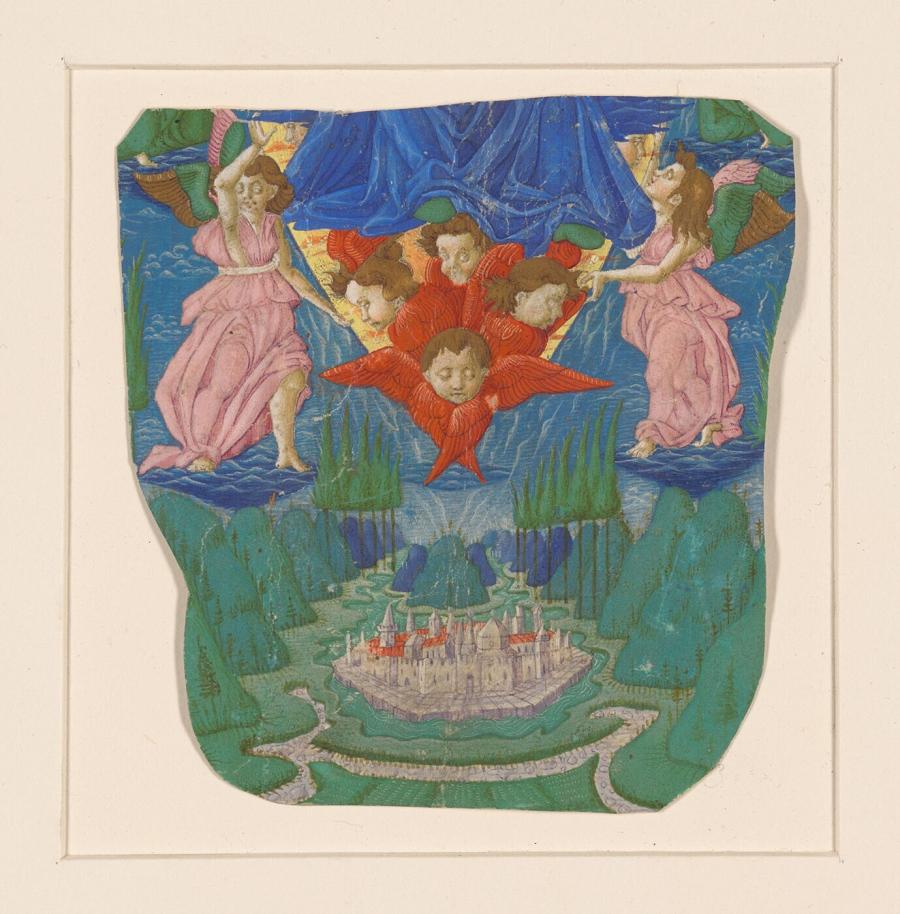
This fragment cut out from an illuminated antiphonal, depicts the lower part of a scene with the Assumption of the Virgin.[1] The sheet has clear cut edges, though it is unclear why the body of the Virgin was separated from the lower part of the scene. It is possible that the upper part was damaged, or that the miniature was cut into several pieces by a dealer in order to sell parts of the composition separately. Even though this scene was originally part of a larger composition and is thus now stripped of the linguistic context that very fundamentally framed it, its survival shows that it was nonetheless appreciated as a small painting in its own right.
The lower part of the fragment depicts a landscape with a meandering river in the foreground that marks the shape of a city. The hexagonal walls of the city might represent an idealized picture of a holy city such as Jerusalem, or could reference an Italian city related to the commissioner of the antiphonal. The city is surrounded by enormous conical shaped trees. Behind it a mountain rises flanked by characteristically Tuscan cypress trees with long trunks and triangular-shaped crown. They point high up in the sky emphasizing the upward movement of the Assumption scene. Above the city four cherubim with red wings hover in the sky, marking the division between the earthly and the heavenly realms. On either side of the cherubim two angels in undulating pink robes and pink, green and gold wings, hold on to a mandorla largely covered by Mary’s blue garments. The painter employed atmospheric perspective to create a sense of depth and vastness of the space. In the upper tier of the miniature white highlights in the blue background seem to indicate water, possibly a reference to an ancient title for Mary: Star of the Sea.
The antiphonal from which this fragment was cut is likely to be a Sanctorale embedded somewhere after the middle of the book. Because the fragment tapers on the bottom, cut approximately to the contours of the letter V, we may infer that the miniature is part of an historiated initial. It likely introduced the chant for a feast related to the Virgin Mary, possibly the antiphon Virgo prudentissima quo progrederis … (Most prudent Virgin, where are you going …) sung at first Vespers for the feast of Assumption celebrated on 15 August. This chant was commonly illustrated by a scene of Mary’s Assumption. On the verso of the fragment, there are red stave lines with musical annotations and the text from a chant which includes the words: …[…u]s salva d[…] (…save …). This chant was possibly sung on or around 15 August as well.
The relatively large size of the fragment indicates it originates from a hefty parental liturgical book from Italy, where large choral manuscripts were treasured. Though the style and iconography of the illumination point to a Florentine origin for the miniature, it is challenging to pinpoint the exact workshop. A focus on the architecture and the serpentine positions of the angels’ bodies and their undulating drapery point to the workshop of Ser Ricciardo di Nanni (active c.1449-1480) especially his depiction of the Allegory of Nature in Pliny the Elder’s De Naturalis Historiae.
This unpublished cutting came into the museum’s collection as part of a significant donation of drawings and prints of Adriaan Domela Nieuwenhuis in 1923. The inventory of his collection shows that aside from drawings and prints he also owned miniatures and manuscript fragments originating from Italy, Germany, and France. The pencilled ‘3’ on the verso indicates it may previously have been part of a larger collection of similar objects.