


A Magnificent Prospect
The depot is real. There it stands, built from thousands of kilos of steel and concrete, but at the same time somehow otherworldly. As if it had landed on earth like some sort of comet or meteorite. A building somewhere between science and fiction. It defies the laws of nature and architecture. It is the triumph of the imagination, of the belief in what can be done. Novelist Ernest van der Kwast, museum director Sjarel Ex and the architect Winy Maas let their dreams free in the depot.
Text: Ernest van der Kwast.
It’s quiet in Eendrachtsplein and Abdi isn’t here yet. I’m two minutes early for our appointment. I’ll be interested to see how late he will be. The later Abdi is, the worse things are with him. If he doesn’t turn up, and doesn’t answer his phone either, I will have to cycle to his house, ring the bell, ring the bell again, sometimes shout up, too, and then wait until he sticks his head out of the window. In the best case, he’s rubbing the sleep out of his eyes and he’s forgotten the appointment. In the worst case… No, I don’t want to go there. That was a long time ago.
I’ve known Abdi for almost four years now, through a mentoring project. I’m his buddy, I help him sort out his shit. Twenty thousand euros in debt, six months’ rent arrears, a housing association that wants to throw him out on the street. And the small things, too: a bag of groceries, a bike, a walk in the park. And lots and lots of conversation.
It’s one minute to ten, and Abdi’s standing in front of me. ‘You’re early,’ I say.
‘Yeah, man.’
We cross over Westblaak and walk to Het Nieuwe Instituut. We’ve got a bench there, like lovers have a bench in parks or big cities like Paris and New York. On the bench by Het Nieuwe Instituut we’ve talked, shouted, sworn, cried, sat in silence and stared at the water, or the surroundings, including pretty girls walking by or, better yet, cycling past in miniskirts full of summer.
The last few times we’ve been looking more and more at the Boijmans Van Beuningen depot. Sitting on our bench, we’ve watched it rise, we’ve seen the concrete walls hoisted up, we’ve seen the mirrors being fitted. Abdi has also watched the trees being hauled up to the roof. He’s a big fan of the building. Sometimes he cycles there from his house to see how it’s progressing, look at the magic of the building. ‘You won’t believe it, man,’ he told me. ‘They’ve just planted trees on the roof! Great big trees you normally see in the woods!’
‘I’m fucked,’ he says now, sitting on the bench one and a half metres away from me. ‘It’s bad, man.’
For a moment I’m afraid he’s going to tell me he’s relapsed. For a long time, his greatest enemy was cannabis. But he beat that demon, after he’d wasted away to nothing and I dragged him to a clinic, and six months later to another one in the woods, after he’d turned himself inside out, after he’d fought like a lion.
‘Have you been smoking weed?’ I ask.
‘No man. Are you crazy?’
Abdi says he’s had enough. He sits at home all day, has no work, no prospects any more, and has to manage on fifty euros a week, the emergency allowance he gets from the credit bank that’s helping him with his debts. Just as things were looking up for Abdi, just as he was scrambling up out of that deep valley, coronavirus arrived. Everything stopped. He was supposed to do a work placement with a large company, he wanted to work on his future. ‘Now nothing’s happening. I’m going crazy, man. The walls are closing in on me.’
‘It’s a difficult time,’ I say.
‘It’s a terrible time.’
‘I haven’t got a solution at the moment. All you can do is stick it out.’
‘Do you know how hard it is to stick it out if you’ve only got fifty euros a week?’
I don’t know. It’s a difficult time for me too: a lot of commissions have been scrapped, but fortunately some work is carrying on. It’s not much, but I don’t have to turn to the government for help.
‘You can do magic,’ says Abdi suddenly. ‘You said you can do magic. Why don’t you do that now?’

He has an infallible memory. Sometimes Abdi reminds me of things I’ve long forgotten.
‘Don’t you remember? You were angry with me; you’d arranged some work but I didn’t answer my phone.’
It was work in a museum. They were looking for guides for a new exhibition. Ideal for Abdi, who’s very sociable and likes interacting with people. I’d helped him write a job application. He got the job but lapsed back into his addiction. He didn’t show up, didn’t respond to messages, didn’t answer his phone. Two months later there was a photograph of the exhibition opening on the front page of the newspaper: Queen Máxima with two exhibition guides.
From a threatened eviction with a mountain of debts to a place beside the queen. It had been possible …
‘You know that I can do magic,’ I had told Abdi when he had kicked the habit. ‘Only my magic doesn’t work if you’re not there.’
He’s here now. He’s sitting beside me, he’s a hundred percent clear and with it.
I look at the depot, at the hundreds of mirrors, at the skyline reflected in them. You can look a long way and see a lot. I see the Erasmusbrug, and the Delftse Poort too. It is a magnificent prospect.
‘It’s going to open next year,’ I tell Abdi. ‘Imagine if you could work there.’
‘No, man. I’ll never get in there.’
‘I’ll magic you in,’ I say. ‘I’ve been asked to write a story about the building, and in that story you’re working in the new Boijmans depot.’
‘As a dishwasher again, I suppose?’
The last job I arranged for Abdi was washing up in a restaurant belonging to a friend of mine. Abdi stuck it out for two months. Working flat out for just fifty euros a month, no one can keep that up.
‘No, as a host. You welcome people from all over the world, delegations from Japan and the United States, a Saudi-Arabian sheik, art collectors, museum directors.’
A smile crosses Abdi’s face, but then he says: ‘It’s a story.’
‘No, it isn’t.’

Ernest van der Kwast (1981) is a writer and presenter of 'Boek & Meester' and the monthly talk show Rotterdam Late Night. His major new novel Ilyas comes out in October. He helps young people get their lives back on track through Rotterdamse Douwers.

Is This a Building?
Text: Sjarel Ex.
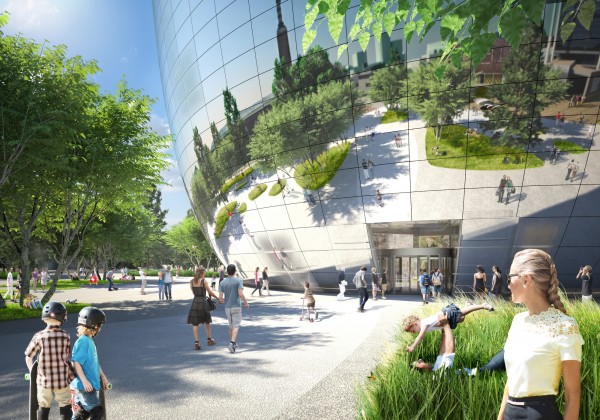
They arrived last autumn: hundreds and hundreds of them, convex mirrors made by craftsmen in China. Swaying cherry pickers lifted the enormous glass plates high in the sky. Little by little, the facade reflects a combination of city and sky. Each placement reveals a piece of the puzzle. Everything reduced to ten percent of the actual size. The effect was amazing, not to say staggering, from the very first one. You almost can’t believe what you’re seeing – you start to look and you can’t take your eyes off the fascinating spectacle. A rainbow in the city looks extra sharp. The mirror image ripples and dances because each panel differs by millimetres. You see yourself in the mirror wall and with a step further you disappear in the panorama of the city. A mirage? ‘This is not a building’ (‘Ceci n’est pas un bâtiment’) I hear René Magritte say. In the sun everything is bright blue, then you’re in the clouds. Like ... yes, just like Dalí’s lovers.
Overcast days are dark and dreary. The half-light reveals Rotterdam’s twinkling skyline. Would Jules Deelder have seen it like that? Did our ‘night mayor’ see this fairy-tale side of Rotterdam laid bare by the mirror? Heading from Mathenesserlaan to the depot I imagine myself in a film noir, in a wide boulevard in Paris, and I whistle a chanson. But from Witte de Withstraat the building looks almost like a large, rather shy head, furtively eyeing the street. Breaking ranks. Take a look at Philip Guston’s oeuvre to see how he would have painted it. Starting next summer, you will see the cinema in the square from the balconies of apartment blocks in the centre. Then the depot will act like a traditional spyhole that lets you look round corners. Architecture spawned in Winy Maas’s imagination, linking the skyline, the surroundings and the people. Not surreal, but real, finished with a tuft of Siberian green.
A Reflecting Park Dream
Text: Winy Maas.
Museumpark and I go back a long way; when landscape architect Yves Brunier designed the park with OMA in the nineteen-nineties I helped with the selection of the first trees. In April, seventy-five specially cultivated birch trees were hoisted to the top of the depot as the start of our planned roof woodland, a fantastic moment! It has come full circle, because the depot was born out of its relationship with Museumpark; we didn’t want it to touch the ground, it had to seem to float above it. The mirrored facade magnifies the park two or three times. In the first stage of the design I had already dreamed of a park where there was not only life during the day – with people on recliners in the rose garden enjoying the sun reflected in the depot – but at night too. With fireflies and light projections by artists who will soon be able to use the facade as a canvas.
Depot Journal
This article has been published before in Depot Journal #4 which is part of a series of six. If you would like to receive all the printed Depot journals by post, please send an email to info@boijmans.nl with your full name and address, reference ‘receive Depot Journals’.