:host { --enviso-primary-color: #FF8A21; --enviso-secondary-color: #FF8A21; font-family: 'boijmans-font', Arial, Helvetica,sans-serif; } .enviso-basket-button-wrapper { position: relative; top: 5px; } .enviso-btn { font-size: 22px; } .enviso-basket-button-items-amount { font-size: 12px; line-height: 1; background: #F18700; color: white; border-radius: 50%; width: 24px; height: 24px; min-width: 0; display: flex; align-items: center; justify-content: center; text-align: center; font-weight: bold; padding: 0; top: -13px; right: -12px; } .enviso-dialog-content { overflow: auto; } Previous Next Facebook Instagram Twitter Pinterest Tiktok Linkedin Back to top
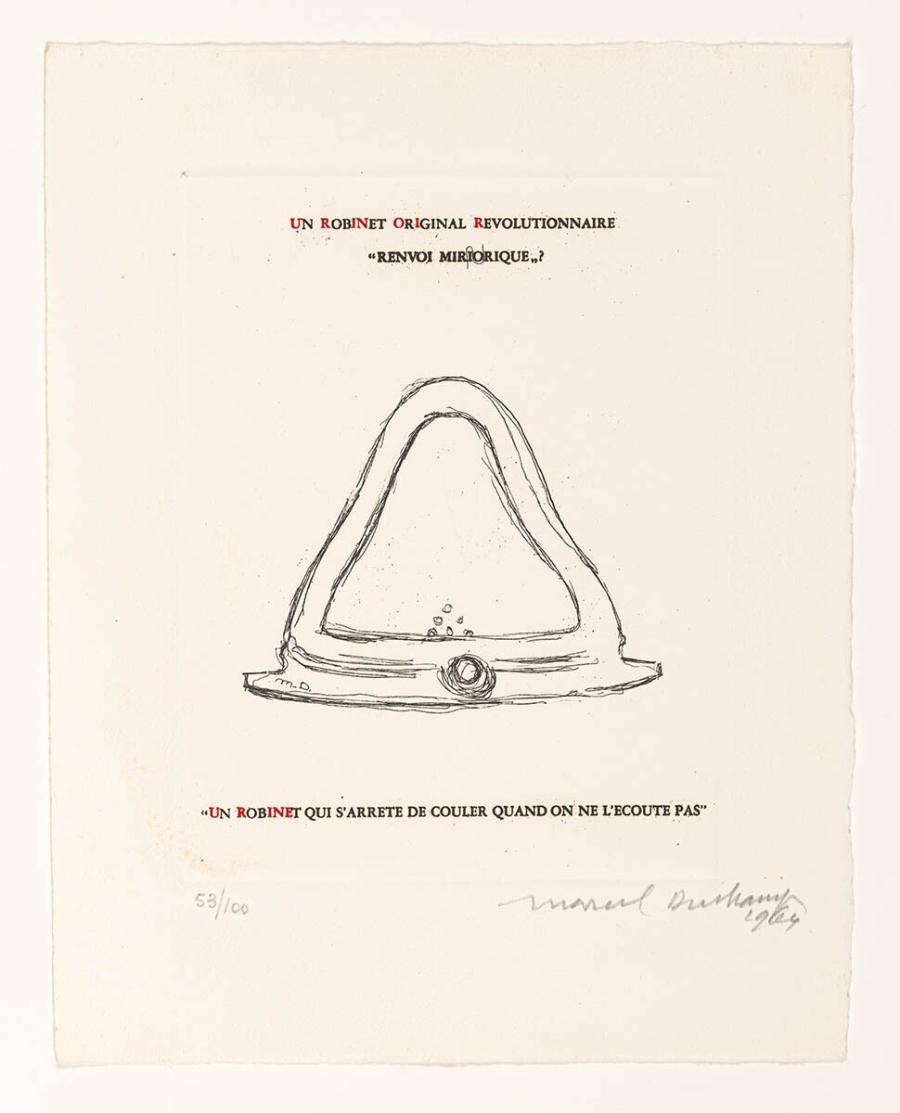
An Original Revolutionary Faucet: “Mirrorical Return”?

An Original Revolutionary Faucet: “Mirrorical Return”?

Marcel Duchamp (in 1964)

Ask anything

Loading...

Thank you. Your question has been submitted.

Unfortunately something has gone wrong while sending your question. Please try again.

Request high-res image

More information

Specifications

Title An Original Revolutionary Faucet: “Mirrorical Return”?
Material and technique Colour etching
Object type
Print > Two-dimensional object > Art object
Location This object is in storage
Dimensions Height 175 mm
Width 134 mm
Artists Artist: Marcel Duchamp
Accession number MB 1990/7 (MK)
Credits Purchased 1990
Department Modern Art
Acquisition date 1990
Creation date in 1964
Provenance Arturo Schwarz, Milan; Diego Strasser, Verona; Gianni Morghen, Arco; Galerie A, Amsterdam
Exhibitions Milan 1964a; Rotterdam 1996a
External exhibitions Humor - 101 jaar lachen om kunst (2017)
Research Show research A dream collection - Surrealism in Museum Boijmans Van Beuningen
Literature Naumann 1999, p. 245; Schwarz 2000, p. 840, cat. no. 606; Von Berswordt-Wallrabe 2003, pp. 199-201
Material
Object
Technique
Colour etching > Etching > Manual > Intaglio printing techniques > Printing technique > Technique > Material and technique
Geographical origin France > Western Europe > Europe

Entry catalogue A dream collection - Surrealism in Museum Boijmans Van Beuningen

Author: Bert Jansen

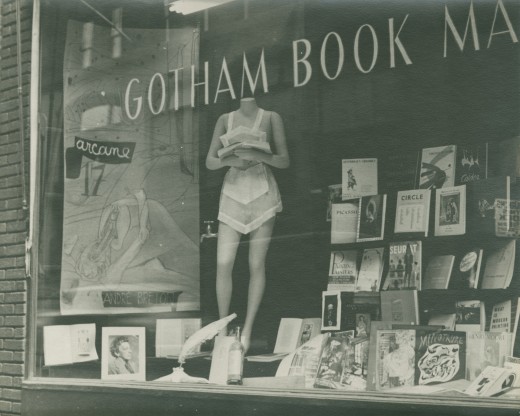
Marcel Duchamp’s shop window design 'Lazy Hardware', Gotham Book Mart, New York, 1945. Philadelphia Museum of Art, Library & Archives

This etching shows the same image as the imitation leather binding in the publication Marcel Duchamp, Ready-Mades Etc. (1913-1964). The only difference is that an ‘i’ and an ‘o’ have been reversed (miriorique) in renvoi miroirique (mirrorical return) and that some letters have been printed in red. These red letters, which were added by using a separate etching plate, together form the words ‘urinoir’ and ‘urine’.

According to Duchamp’s gallerist, Arturo Schwarz, the etching referred to a shop window the artist had fitted out in 1945 at André Breton’s invitation for the presentation of his book Arcane 17 in Brentano’s bookshop on Fifth Avenue in New York.[1] Duchamp put a headless mannequin in an apron in the shop window. In her hands she had an open book and a tap stuck out from her leg. The title was Lazy Hardware, possibly a play on words of ‘lady hardware’ given that the shop window mannequin represented a woman. The window display was on view for a mere twenty minutes because of a protest by the League of Women, which found the figure offensive. Duchamp then fitted out a similar shop window at the Gotham Book Mart on West 47th Street which – despite fierce protests – remained in place for a week.

Lazy Hardware should be understood in the light of a sentence on one of the revolving discs in Duchamp’s film Anémic Cinéma made in 1926: ‘Among our lazy domestic articles we recommend the faucet that stops dripping when nobody is listening to it’. The last part of this sentence also appears on the etching. In conjunction with the image of a urinal the inscription takes on an indecent meaning, reminiscent of the exhibition staged in 1917 by the Society of Independent Artists in New York, where Duchamp tried in vain to exhibit the readymade of a urinal under the title Fountain. In an interview in 1964 Duchamp remarked that he had always opposed good taste and that was why he had chosen a urinal.[2] But he also wanted to demonstrate that as an artist you could make people accept anything and that art was a dream world, a mirage of an oasis like those that appear in the desert when you are almost dying of thirst. But in art you don’t die of thirst, he would continue, there the mirage endures.


Footnotes

[1] Schwarz 2000, p. 781.

[2] Stauffer 1991, p. 174.

Show research A dream collection - Surrealism in Museum Boijmans Van Beuningen
Show catalogue entry Hide catalogue entry

All about the artist

Marcel Duchamp

Blainville-Crevon 1887 - Neuilly-sur-Seine 1968

Marcel Duchamp can be considered one of the founders of Dadaism and conceptual art. He became famous for, among other things, his 'ready mades': existing...

Bekijk het volledige profiel