:host { --enviso-primary-color: #FF8A21; --enviso-secondary-color: #FF8A21; font-family: 'boijmans-font', Arial, Helvetica,sans-serif; } .enviso-basket-button-wrapper { position: relative; top: 5px; } .enviso-btn { font-size: 22px; } .enviso-basket-button-items-amount { font-size: 12px; line-height: 1; background: #F18700; color: white; border-radius: 50%; width: 24px; height: 24px; min-width: 0; display: flex; align-items: center; justify-content: center; text-align: center; font-weight: bold; padding: 0; top: -13px; right: -12px; } .enviso-dialog-content { overflow: auto; } Previous Next Facebook Instagram Twitter Pinterest Tiktok Linkedin Back to top
Study for Adam and Eve

Ask anything

Loading...

Thank you. Your question has been submitted.

Unfortunately something has gone wrong while sending your question. Please try again.

Request high-res image

More information

Specifications

Title Study for Adam and Eve
Material and technique Black chalk on paper
Object type
Drawing > Two-dimensional object > Art object
Location This object is in storage
Dimensions Height 277 mm
Width 435 mm
Artists Draughtsman: Jacopo Tintoretto (Jacopo Comin, Jacopo Robusti)
Accession number I 81 (PK)
Credits Loan Stichting Museum Boijmans Van Beuningen (former Koenigs collection), 1940
Department Drawings & Prints
Acquisition date 1940
Creation date in circa 1578-1579
Watermark none (vV, 7?P)
Inscriptions 'Tintorett' (verso, below right of centre, pen and brown ink), '16' (verso, below right, pencil)
Collector Collector / Franz Koenigs
Mark customs stamp 3.Hbf.St.Riehig / Berlin Mt.2, F.W. Koenigs (L.1023a)
Provenance Francesco II d'Adda, conte di Sale, Milan (-1641), album of drawings from c. 1630-40, Elenco no. 2; - ; Art dealer Paul Cassirer & Co., Amsterdam; Franz W. Koenigs (1881-1941, L.1023a), Haarlem, acquired in 1926; D.G. van Beuningen (1877-1955), Rotterdam, acquired with the Koenigs Collection in 1940 and donated to Stichting Museum Boijmans Van Beuningen
Exhibitions Haarlem 1926; Amsterdam 1929, no. 299; Paris 1935, no. 712; Rotterdam 1952, no. 96; Rotterdam 1957, no. 43; Paris/Rotterdam/Haarlem 1962, no. 111; Venice/Florence 1985, no. 36
Internal exhibitions Tekeningen uit eigen bezit, 1400-1800 (1952)
Italiaanse tekeningen in Nederlands bezit (1962)
Research Show research Italian Drawings 1400-1600
Literature Von Hadeln 1926b, p. 19, pl. 25; Amsterdam 1929, no. 299; Von Hadeln 1933, pl. 10; Paris 1935, no. 712; De Tolnay 1943/79, no. 132, ill.; Tietze/Tietze-Conrat 1944, no. 1660, pl. 108.2; Tietze 1948, pp. 45 ff; Haverkamp Begemann 1952, no. 96; Haverkamp Begemann 1957, no. 43, ill.; Paris/Rotterdam/Haarlem 1962, no. 111, pl. 83; Schulz 1968, p. 90, fig. 83; Rossi 1975, p. 64 (rejected attr.); Rearick 1980, p. 34 under no. 12, p. 35 under no. 13; Aikema/Meijer 1985, no. 36, ill.; Rearick 1996, p. 177 n. 3 (Jacopo); Rearick 2001, pp. 159, 227; Rossi 2007, no. 64 (Jacopo); Marciari 2018, pp. 131, 141 n. 33
Material
Object
Geographical origin Italy > Southern Europe > Europe
Place of manufacture Venice > Veneto region > Italy > Southern Europe > Europe

Do you have corrections or additional information about this work? Please, send us a message
Entry catalogue Italian Drawings 1400-1600

Author: Albert Elen

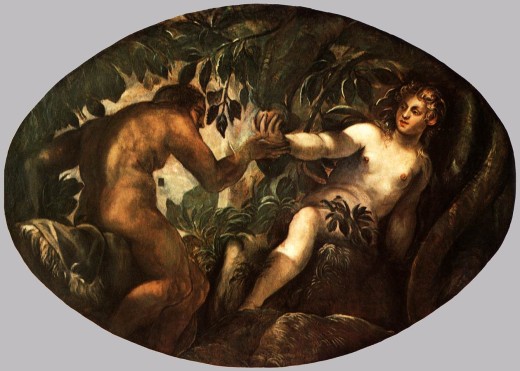
Jacopo Tintoretto, 'The Fall of Man', 1577-78, oil on canvas, 265 x 370 cm, Scuola di San Rocco, Venice. Photo Web Gallery of Art

In contrast to the multitude of drawings of single figures, compositional designs are rare in the artist's oeuvre. This drawing of Adam and Eve, placed in oval and diamond frames and squared for transfer, is preparatory to The Fall of Man (fig.), part of the decorative scheme of 13 paintings on the ceiling of the Sala Grande in the Scuola di San Rocco in Venice (1577-78).[1] Having doubted the attribution to Jacopo Tintoretto at first, Rossi (2007) revised her opinion, agreeing with all other authors that this is indeed an autograph drawing. There was a drawing attributed to Domenico Tintoretto (1560-1635), which derives from the Rotterdam sheet, in the art market.[2] It faintly shows the same grid, but not all over, and leaves out the oval and diamond frames, as well as Adam’s left leg. It mainly follows the contours of the figures, with flowing and sometimes repeated outlines.

In another, much earlier depiction of this scene, which was part of the decorations of the Scuola della Trinità (1550-53) and is now in the Gallerie dell'Accademia in Venice, the figures are represented in opposite postures, with Adam leaning back and Eve bending over towards him offering the apple.[3]

Another drawing in the Koenigs Collection (I 74 recto), which is probably related to the earlier composition design for Paradise now in the Louvre, shows a reclining male nude, which resembles the figure of Eve in our drawing, except for her right arm, whereas the I 74 verso shows three entangled sketches, one of which seems to relate to the reclining figure of Adam in the Scuolo della Trinità painting, another being a repetition of the reclining figure on the recto. It would seem Tintoretto revisited the earlier drawing, which was kept as reference material in the workshop.

Footnotes

[1] De Vecchi 1970, no. 223 D, ill.; Pallucchini/Rossi 1982, no. 335, fig. 436.

[2] Until recently in an Italian private collection; Marciari (2018), p. 141, n. 33; sale, Vienna (Dorotheum) 03.04 2020, lot 106, ill.. In the opinion of the present author this drawing is by Cézanne, an admirer of the work of Tintoretto, judging the double contours of the silhouette.

[3] De Vecchi 1970, no. 82 C, pl. 8. See also our drawing inv. I 74.

Show research Italian Drawings 1400-1600
Show catalogue entry Hide catalogue entry

All about the artist

Jacopo Tintoretto (Jacopo Comin, Jacopo Robusti)

Venetië 1518/1519 - Venetië 1594

Bekijk het volledige profiel