:host { --enviso-primary-color: #FF8A21; --enviso-secondary-color: #FF8A21; font-family: 'boijmans-font', Arial, Helvetica,sans-serif; } .enviso-basket-button-wrapper { position: relative; top: 5px; } .enviso-btn { font-size: 22px; } .enviso-basket-button-items-amount { font-size: 12px; line-height: 1; background: #F18700; color: white; border-radius: 50%; width: 24px; height: 24px; min-width: 0; display: flex; align-items: center; justify-content: center; text-align: center; font-weight: bold; padding: 0; top: -13px; right: -12px; } .enviso-dialog-content { overflow: auto; } Previous Next Facebook Instagram Twitter Pinterest Tiktok Linkedin Back to top
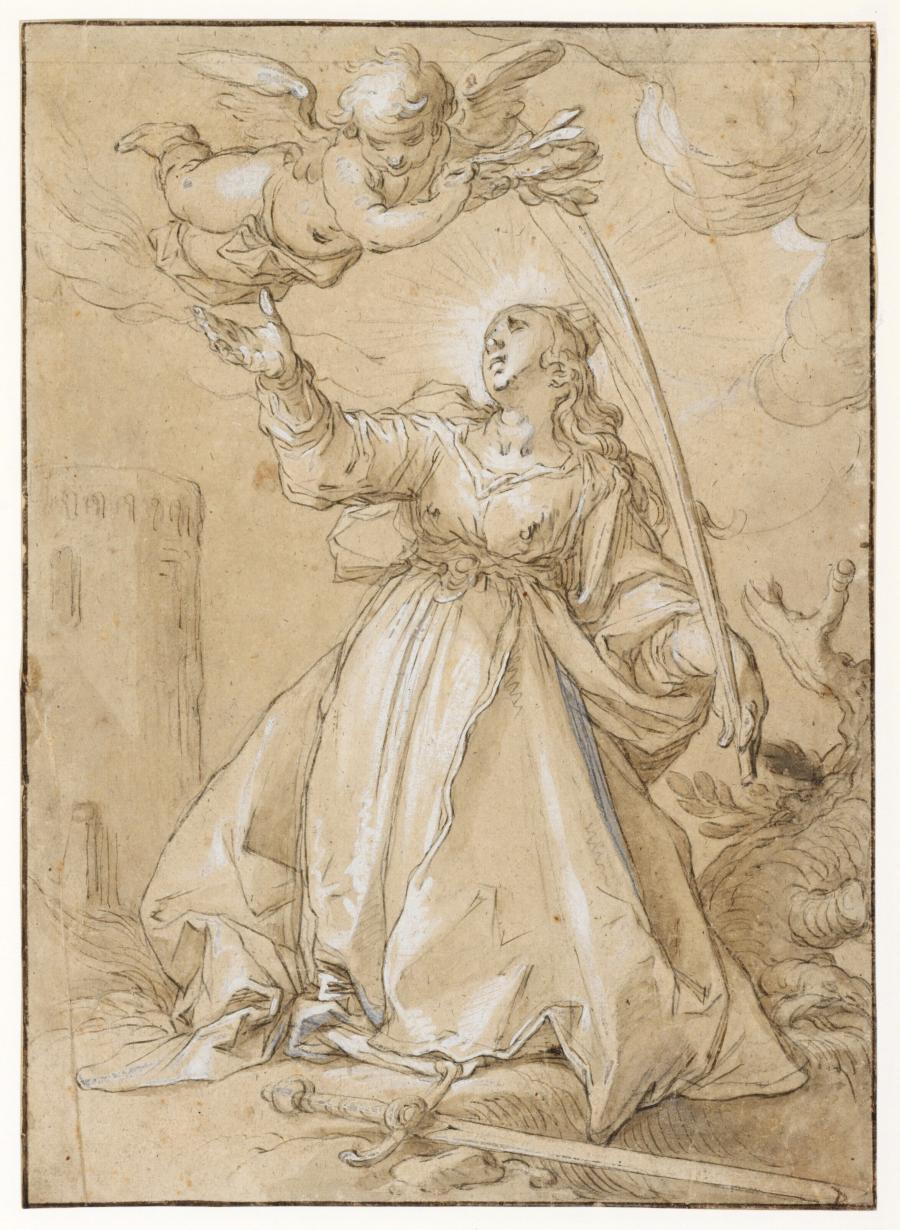
Female Martyr (St Barbara)

Ask anything

Loading...

Thank you. Your question has been submitted.

Unfortunately something has gone wrong while sending your question. Please try again.

Request high-res image

More information

Specifications

Title Female Martyr (St Barbara)
Material and technique Black chalk, pen and brown ink, brown wash, heightened with white, framing lines with the pen in brown ink
Object type
Drawing > Two-dimensional object > Art object
Location This object is in storage
Dimensions Height 263 mm
Width 190 mm
Artists Draughtsman: Abraham Bloemaert
Accession number AB 7 (PK)
Credits Purchased 1891 (?)
Department Drawings & Prints
Creation date in circa 1610-1615
Signature none
Watermark none (vH, 7P)
Condition two sharp vertical folds at lower left and top right, the vertical white heightening on the right side of the mantle has oxidized grey
Inscriptions none
Mark none
Provenance (?) Samuel van Huls; his (†) sale, The Hague (Swart), 14 May 1736 sqq., Album K, no. 443 (‘Ste Barbe’, together with a ‘Ste. Catherine’); (?) G.H. Moll, his (†) sale, Rotterdam (Oldenzeel et al.), 20-23 (20) April 1891, no. 58 (‘De vredeboodschap’), together with another drawing by Bloemaert (‘de boetvaardige’), to the museum
Exhibitions none
Research Show research Netherlandish Drawings of the Fifteenth and Sixteenth Centuries
Literature Jaarverslag 1891, p. 5 (?); cat. 1901, p. 23, no. 40 (?); Bolten 2007, no. 327
Material
Object
Technique
Highlight > Painting technique > Technique > Material and technique
Brown wash > Washing > Wash > Drawing technique > Technique > Material and technique
Geographical origin The Netherlands > Western Europe > Europe

Entry catalogue Netherlandish Drawings of the 15th and 16th Centuries.

Author: Albert J. Elen

This drawing may have served as an intermediary model for the lost design[1] for the engraving by Boëtius Adamsz. Bolswert[2], which was one of a set of three devotional prints of martyr saints (Stephen, Barbara and Catherine). A slightly larger version of the Rotterdam sheet, probably a copy, is now in Florence.[3] Taking into account the reversed image, the print differs from this preliminary drawing mainly in the upper part of the saint, the palm branch switched to her other hand and the empty hand held up in a different position, the head changed from three-quarters view into profile. These changes Bloemaert had probably worked out in the final design, now lost.

            Details in our drawing can be better recognized when compared with the print, in which they are rendered in greater detail. At left is the tower in which Barbara was secluded by her father Dioscorus to protect her from the outside world. It is her main attribute in representations. In front of the tower is the bathhouse, barely indicated in the drawing, which her father had erected for her. When she escaped from there, after having been converted to the Christian faith and refusing to marry, her father captured her and brought her to justice. After a long ordeal of torture, her wounds healing miraculously, she was eventually beheaded by her own father. Hence the sword lying at her feet. The palm branch is a common symbol of martyrdom. The flying putto above her is holding a wreath above her already crowned head. It is clear why Bloemaert changed the position of her upheld right arm; this was to prevent it from overlapping and thus visually touching the putto.

Possibly the Rotterdam sheet can be identified with the drawing of St. Barbara, which was sold together with a drawing of St. Catherine in the Van Huls sale in 1736. The second drawing is now in Copenhagen.[4]

Footnotes

[1] Bolten 2007, no. 326. Bolten refers to this drawing as a sketch, whereas it is a finished composition with a certain degree of perfection.

[2] Bolten 2007, vol. 1 under nos. 326-327, vol. 2, ill. 326a.

[3] Uffizi, inv. no. 8729 S.; Bolten 2007, vol. 1 under no. 327, vol. 2, ill. 327a.

[4] Copenhagen, Statens Museum for Kunst, inv. no. Tu 82a, 4. Bolten 2007, no. 328.

Show research Netherlandish Drawings of the Fifteenth and Sixteenth Centuries
Show catalogue entry Hide catalogue entry

All about the artist

Abraham Bloemaert

Gorinchem 1566 - Utrecht 1651

Bekijk het volledige profiel