Author: Katinka Duffhuis
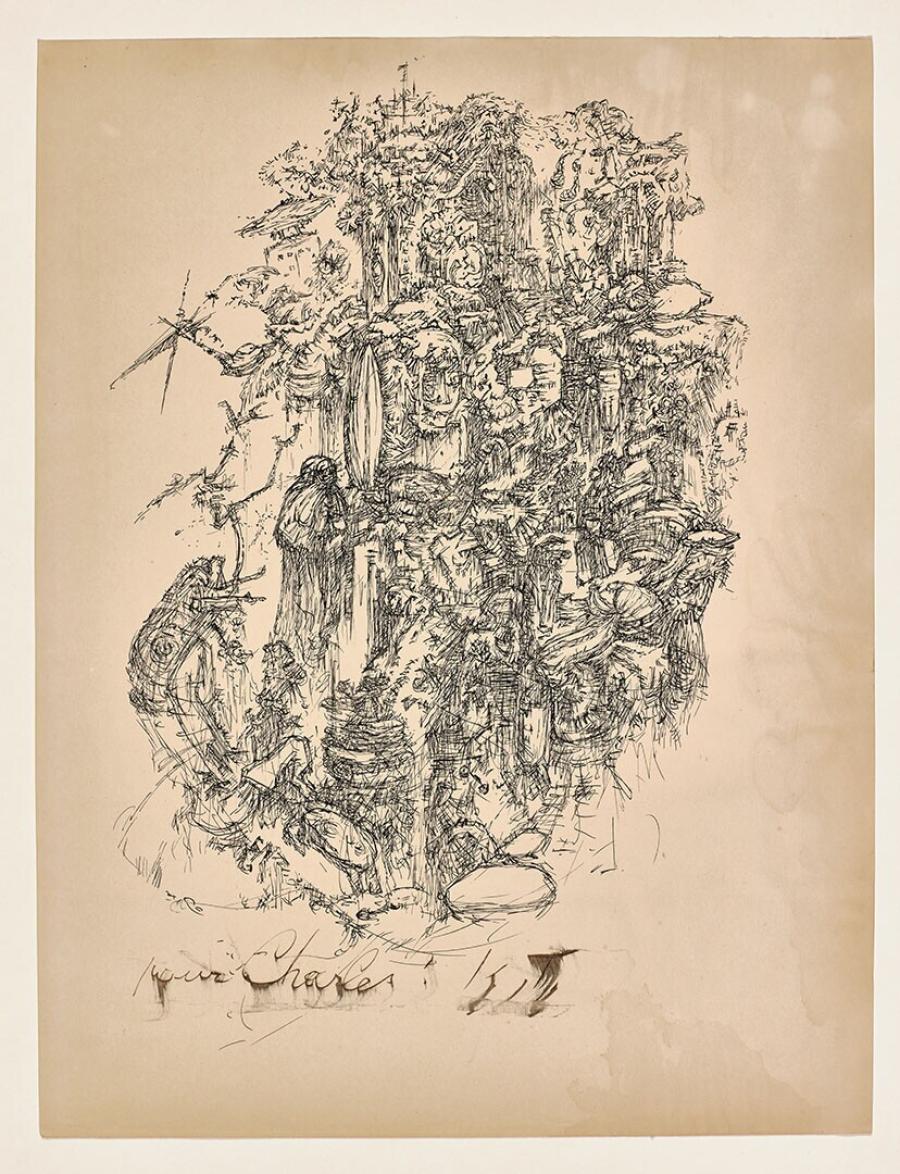
In the 1930s Kristians Tonny made several journeys that influenced his work. From 1930 to 1932 he lived in Tangiers (Morocco), and in 1937 he spent a long time travelling through the United States, Mexico and Guatemala. In 1949, having been abroad for more than thirty years, Tonny finally went to live in his birthplace, Amsterdam, with his future wife Eeke van der Schaaf. Compared with the years he spent in Paris he lived a secluded life there, but remained active as an artist. During that period he exhibited less: he could not get a foothold in the Dutch art world, where Surrealism had never had the same influence as it did in Paris.[1] In 1964 the art critic Hans Redeker wrote: ‘From this Gallicised and Parisian wunderkind emerged the post-war Kristians Tonny, wandering around the cafés and terraces of the Leidseplein, almost forgotten as an artist, written off, a stranger in an artistic climate dominated by different and mainly abstract manifestations.’[2] Contact with the international group of Surrealists petered out when he lived in Amsterdam, but from 1967 onwards Tonny took part in the activities of the Dutch Surrealist circle of the Bureau de Recherches Surréalistes en Hollande, which had been set up some ten years previously by the artist Her de Vries.[3] Tonny lived in Amsterdam’s Stadionbuurt, where he could regularly be found in the café restaurant in Stadionplein. The owner Charles van Dijk took Tonny under his wing and on several occasions wrote off an outstanding account when Tonny did not have enough money to settle it. As a token of thanks, or in exchange for an unpaid debt, Tonny gave him a number of his works on paper, including these two drawings now owned by Museum Boijmans Van Beuningen. One of the works is inscribed ‘Pour Charles’.[4]
Tonny probably made the drawings in the 1960s after he had abandoned the transfer technique because the intense concentration it required placed too much of a strain on his eyes.[5] He concentrated on making paintings and pen drawings and also worked automatically. By making short movements with the pen, sometimes bold, sometimes slightly more subtle, he produced different compositions. The drawing can be read as a whole to begin with, but each individual part yields a new discovery in the jumble of lines and shapes. Even though these compositions were not drawn blind, the line, paradoxically, was more searching than the earlier transfer drawings. Art critics often compare Tonny’s work with that of Jheronimus Bosch, Pieter Bruegel the Elder and William Blake because of the figures that emerged from this approach.[6] In 1968 Redeker wrote about Tonny’s work in the Algemeen Handelsblad: ‘His imaginary world is still bizarre, populated by human and animal beings that stand out as compressions within the complicated interplay of lines of his landscape visions… like the emaciated vagrants and jailbirds in the overgrown ruins of Piranesi’s views of Rome or Tivoli’.[7]